
Java Programming: Solving Problems with Software
This course, offered by Coursera, was developed by Duke University. It is comparable to the introductory Java course taught to Duke students, and it can be applied to multiple specialization certificate programs. It takes a little over 13 hours to complete and is designed as a 4-week curriculum.
Created by: Owen Astrachan
Produced in 2015
 What you will learn
- Editing, compiling and running Java programs
- Conditionals and loops
- Java API documentation
- Debugging and the scientific method
- Practical application of solving problems with Java programs
- Utilizing test cases
- Class creation and use
- Techniques to use multiple methods in a single program
 Quality Score
Overall Score : 96 / 100
 Live Chat with CourseDuck's Co-Founder for Help
 Course Description


 Pros
Pros
 Cons
Cons
-
- Course challenges students to ensure that lessons lead to a deep understanding of concepts and applications.
- Forums and online peer resources empower students to overcome challenges and learn more in the process.
- When used towards specialization, course helps acquire valuable professional certifications.
-
- This may be an introductory course, but it is not designed for beginners. A coding or computer science background is expected for students to succeed.
- Assignments are challenging to a degree disproportionate with the difficulty of the lessons.
- Time to complete challenges may dramatically eclipse time required to get through lectures.
 Instructor Details

- 4.8 Rating
 153 Reviews
Owen Astrachan
Owen Astrachan is a Professor of the Practice in the Department of Computer Science at Duke University. He has taught computer science at Duke for more than 25 years and taught high school for seven years before starting at Duke. In recent years, Professor Astrachan has worked with colleagues to redesign Duke's introductory computer science course to reach a broader range of students at Duke from a variety of backgrounds and fields. He also leads the Computer Science Principles project, which is completely grounded in a philosophy of engendering interest in new and previously untargeted/uninterested students, broadening participation in computing. Professor Astrachan received an NSF Career award, the NSF CISE Distinguished Education Fellow award, received two teaching awards at Duke and a teaching award when teaching on a sabbatical leave at the University of British Columbia. Professor Astrachan holds a PhD in Computer Science and a Master of Arts in Teaching (Mathematics), both from Duke University.
 Reviews


- Video Duration:
 25h
25h - Price: Free 0 Track Price
- Provider:
 Coursera
 - University:
 Duke University
 - Year:
 2015
2015 - Level:
 Beginner
 - Language:
 English
 - Certificate:
 Yes
Yes
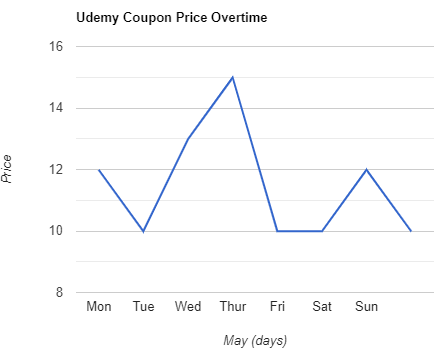
Coursera Coupon Price Tracker