
 Web Development
 Python
 SQL
SQL JavaScript
 Data Science
 Artificial Intelligence
 IT & Software
 IT Certifications
 Hacking
 Arduino
 AWS
AWS 3D Modeling
 Graphic Design
 Photoshop
 Drawing
 Digital Painting
 UX Design
 Business
 Data Analysis
 Communication Skills
 Project Management
 Leadership & Management
 E-Commerce
 Digital Marketing
 Social Media Marketing
 Marketing
 SEO
SEO Google Analytics
 Branding
 Office Productivity
 Excel
Excel Finance & Accounting
 Bitcoin
 Video Editing & Animation
 Photography
 Adobe Premier Pro
 Adobe Lightroom
 Personal Development
 Health & Fitness
 Music
Music Guitar
 Teaching & Academics
 Language Learning
 Engineering
 Lifestyle
Calculus 1, part 1 of 2: Limits and continuity (Udemy.com)
Single variable calculus with elements of Real Analysis: from axioms and proofs to illustrations and computations
Created by: Hania Uscka-Wehlou
Last updated August 2026
 What you will learn
- How to solve problems concerning limits and continuity of real-valued functions of 1 variable (illustrated with 491 solved problems) and why these methods work.
- The structure and properties of the set of real numbers as an ordered field with the Axiom of Completeness, and consequences of this definition.
- Arithmetic on the extended reals, and various types of indeterminate forms.
- Supremum, infimum, and a reformulation of the Axiom of Completeness in these terms.
- Number sequences and their convergence or divergence; the epsilon-definition of limits of sequences, with illustrations and examples; accumulation points.
- Getting new limits from old limits: limit of the sum, difference, product, quotient, etc, of two sequences, with illustrations, formal proofs, and examples.
- Squeeze Theorem for sequences
- Squeeze Theorem for functions
 Course Description
Calculus 1, part 1 of 2: Limits and continuity
Single variable calculus
[None of our courses are produced using AI; they are all real-human products.]
S1. Introduction to the course
You will learn: about the content of this course, and generally about Calculus and its topics.
S2. Preliminaries: basic notions and elementary functions
You will learn: you will get a brief recap of the Precalculus stuff you are supposed to master in order to be able to follow Calculus, but you will also get some words of consolation and encouragement, I promise.
S3. Some reflections about the generalising of formulas
You will learn: how to generalise some formulas with or without help of mathematical induction.
S4. The nature of the set of real numbers
You will learn: about the structure and properties of the set of real numbers as an ordered field with the Axiom of Completeness, and consequences of this definition.
S5. Sequences and their limits
You will learn: the concept of a number sequence, with many examples and illustrations; subsequences, monotone sequences, bounded sequences; the definition of a limit (both proper and improper) of a number sequence, with many examples and illustrations; arithmetic operations on sequences and The Limit Laws for Sequences; accumulation points of sequences; the concept of continuity of arithmetic operations, and how The Limit Laws for Sequences will serve later in Calculus for computing limits of functions and for proving continuity of elementary functions; Squeeze Theorem for Sequences; Weierstrass' Theorem about convergence of monotone and bounded sequences; extended reals and their arithmetic; determinate and indeterminate forms and their importance; some first insights into comparing infinities (Standard Limits in the Infinity); a word about limits of sequences in metric spaces; Cauchy sequences (fundamental sequences) and a sketch of the construction of the set of real numbers using an equivalence relation on the set of all Cauchy sequences with rational elements.
S6. Limit of a function in a point
You will learn: the concept of a finite limit of a real-valued function of one real variable in a point: Cauchy's definition, Heine's definition (aka Sequential condition), and their equivalence; accumulation points (limit points, cluster points) of the domain of a function; one-sided limits; the concept of continuity of a function in a point, and continuity on a set; limits and continuity of elementary functions as building blocks for all the other functions you will meet in your Calculus classes; computational rules: limit of sum, difference, product, quotient of two functions; limit of a composition of two functions; limit of inverse functions; Squeeze Theorem; Standard limits in zero and other methods for handling indeterminate forms of the type 0/0 (factoring and cancelling, using conjugates, substitution).
S7. Infinite limits and limits in the infinities
You will learn: define and compute infinite limits and limits in infinities for functions, and how these concepts relate to vertical and horizontal asymptotes for functions; as we already have learned the arithmetic on extended reals in Section 5, we don't need much theory here; we will perform a thorough analysis of limits of indeterminate forms involving rational functions in both zero and the infinities.
S8. Continuity and discontinuities
You will learn: continuous extensions and examples of removable discontinuity; piece-wise functions and their continuity or discontinuities.
S9. Properties of continuous functions
You will learn: basic properties of continuous functions: The Boundedness Theorem, The Max-Min Theorem, The Intermediate-Value Theorem; you will learn the formulation and the meaning of these theorems, together with their proofs (in both written text and illustrations) and examples of their applications; we will revisit some old examples from the Precalculus series where we used these properties without really knowing them in a formal way (but well relying on our intuition, which is not that bad at a Precalculus level); uniform continuity; a characterisation of continuity with help of open sets.
S10. Starting graphing functions
You will learn: how to start the process of graphing real-valued functions of one real variable: determining the domain and its accumulation points, determining the behaviour of the function around the accumulation points of the domain that are not included in the domain, determining points of discontinuity and one-sided limits in them, determining asymptotes. We will continue working with this subject in "Calculus 1, part 2 of 2: Derivatives with applications".
Make sure that you check with your professor what parts of the course you will need for your final exam. Such things vary from country to country, from university to university, and they can even vary from year to year at the same university.
A detailed description of the content of the course, with all the 225 videos and their titles, and with the texts of all the 491 problems solved during this course, is presented in the resource file
“001 List_of_all_Videos_and_Problems_Calculus_1_p1.pdf”
under Video 1 ("Introduction to the course"). This content is also presented in Video 1.

 Udemy Discount
The discount is applied through our link. Open the course from here and Udemy's current promotional price is applied at checkout on most courses, no code to type.
Some courses are excluded from Udemy's promotions. If the price does not drop, clear your browser cookies and use the button again.
Instructor Details

- 4.7 Rating
 291 Reviews
Hania Uscka-Wehlou
I am a multilingual mathematician with a passion for mathematics education. I always try to find the simplest possible explanations for mathematical concepts and theories, with illustrations whenever possible, and with geometrical motivations.
I worked as a senior lecturer in mathematics at Uppsala University (from August 2017 to August 2019) and at Mälardalen University (from August 2019 to May 2021) in Sweden, but I terminated my permanent employment to be able to create courses for Udemy full-time.
I am originally from Poland where I studied theoretical mathematics and got pedagogical qualifications at the Copernicus University in Toruń (1992-1997). Before that, I enjoyed a very rigorous mathematical education in a mathematical class in high school "Liceum IV" in Toruń, which gave me a very solid foundation for everything else I have learned and taught later.
In my courses I teach various branches of university mathematics that I have learned from absolutely excellent lectures of my dear professors from Toruń: Mirosław Uscki (b.1946), Zbigniew Bobiński (b.1940), Paweł Jarek (1933-2013), and Stanisław Balcerzyk (1932-2005).
My PhD thesis (2009) was at Uppsala University in Sweden, with the title: "Digital Lines, Sturmian Words, and Continued Fractions".
 More courses by Hania Uscka-Wehlou
Calculus 3 (multivariable calculus), part 1 of 2 (2026)
4.8 (444 Reviews)
 Provider: Udemy
 Time: 47.9h
$79.99

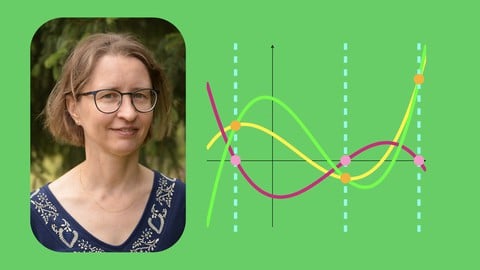
Precalculus 2: Polynomials and rational functions (2026)
4.9 (207 Reviews)
- Provider: Udemy
- Time: 42.1h
$74.99
More Teaching & Academics courses
GMAT Focus | Quantitative| Master Math Course | 2026 Updated
5.0 (854 Reviews)
- Provider: Udemy
- Time: 55.3h
$11.99


Speed Reading MACHINE 5.1: How To Read 307 Books In 2026
4.9 (1,386 Reviews)
- Provider: Udemy
- Time: 7.2h
$12.99
GRE Quantitative Prep | Master Math Course | 2026 Updated
4.9 (980 Reviews)
- Provider: Udemy
- Time: 59h
$10.99
 Reviews

By Jordy Renderos on 3/4/2026
I think it's nice that the instructor has provided a table of contents before starting the course.
By Aryama Maitra on 2/12/2026
The course is really good. I would recommend it to anyone who wants to delve deeper into undergraduate mathematics in a rigorous fashion. I'm looking forward to take the other courses of Dr. Hania and shatter my limits as a mathematics learner!
By Charisma Setyobudhi on 2/10/2026
A good balance between theory of what about to come and its necessary explanation. Not too short not too long explanation.
By Indrayana Putar on 5/29/2025
cerita dirangkai dengan sangat baikm diawali dengan penaduluan bagimana kalkulus diciptakn untuk memeahkna seolus soliue yang tidk bisa dipecahkan dengan cara juno pada zaman dahulu
By Marc R on 5/13/2025
It's ridiculous that Hanias courses are 10€ on sale. They're so good and there just went so much effort and thought into these. It really feels like robbery getting these for such a cheap price. Especially when I think about courses I have taken for several hundreds of euros which did not come even remotely close to the level of quality provided by Hania
By Eric Alcalai Franca on 4/15/2025
As an engineer who learned Calculus about ten years ago, I was truly impressed by what the teacher said in the first video of this course: it's remarkably well-organized and self-contained, with everything easily accessible and, most incredibly, solutions provided for all the exercises. I've just begun, but I'm already in heaven!
By Francisco Ortega on 7/5/2024
What can I say that can be helpful for any student who wants to learn calculus. Well first it is a long and self contained course. You will engage in a lot complementary material that will reinforce the new knowledge. Second there a lot of exercises, that will require effort and time. And last, it is a intermediate course so to may have some percalculus background.
By Stiven Jimenez on 6/27/2024
This course is great, I had never had so much love for mathematics until now. I recommend it to anyone who truly wants to learn how to do mathematics, and even to those who don't, haha. I'm taking this course to dedicate myself to understanding Deep Learning later on. Thanks, Hania, you're the best teacher.
By Ahmet Karahan on 2/1/2024
She explains mathematics as it is, without damaging its beauty, and helps you progress by answering your questions as soon as possible. She is one of the mathematics teachers I value most. None of her courses are superficial and I have no intention of missing any of them. It is also very useful that she helps you see the big picture through the connections she makes between the topics she covers in her courses.
By Wanda Woźnica on 9/23/2023
Very good course. Gives a lot of information about Real Analysis that are often omitted in other courses. It's really great to learn about the abstract axiomatic approach, clarified and illustrated with many practical examples. This is my 13th course by Hania and Martin that I've completed and I can recommend all of them.
 Quality Score
No CourseDuck member has rated this course yet. Taken it? Give each part a thumbs up or down.
Overall Score : 94 / 100
- Video Duration:
 60h
60h - Price: $19.99
- Provider: Udemy
- Updated:
 August 2026
 - Level:
 All Levels
 - Language:
 English
 - Certificate:
 Yes
Yes
30-day money-back guarantee on most paid courses
Udemy Coupon Price Tracker
