
 Web Development
 Data Science
 Python
 SQL
 JavaScript
 Artificial Intelligence
 IT & Software
 IT Certifications
 Hacking
 AWS
 Arduino
 DevOps
 3D Modeling
 Graphic Design
 Photoshop
 Drawing
 Digital Painting
 UX Design
 Business
 Data Analysis
 Communication Skills
 Project Management
 Leadership & Management
 Human Resources
 Digital Marketing
 Social Media Marketing
 Marketing
 SEO
 Google Analytics
 Branding
 Excel
 Office Productivity
 SAP
 PowerPoint
 Microsoft Access
 SharePoint
 Finance & Accounting
 Trading & Investing
 Accounting
 Bitcoin
 Personal Finance
 Video Editing & Animation
 Photography
 Adobe Premier Pro
 Adobe Lightroom
 Personal Development
 Productivity
 Career Development
 Life Coaching
 Health & Fitness
 Meditation & Mindfulness
 Yoga
 Music
 Music Production
 Guitar
 Piano
 Singing
 Language Learning
 Teaching & Academics
 Engineering
 Math
 Lifestyle
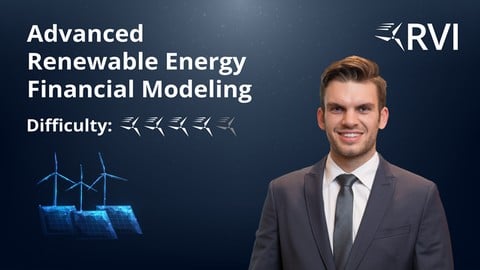
Advanced Renewable Energy Financial Modeling (Udemy.com)
Learn how to build an integrated project finance model for renewable energy investments from scratch.
Created by: Lukas Duldinger
Last updated August 2026
 What you will learn
- Build a fully integrated 3-statement project finance model for renewable energy investments
- Model sculpted debt financing structures and learn how to break common circularities with macros using VBA
- Learn diverse valuation approaches for renewable energy projects
- Model different PPA offtake structures with different hedging ratios
- Learn how to value projects from a developer's or investor's perspective
- Implement P50, P75, and P90 energy yields and dynamically adjust to any other P-value
- Understand contractual relations within a project finance deal
- Build an investment dashboard with dynamic charts and key industry KPIs which support investment decision-making
How it compares
Against the other 376 rated Udemy courses in Finance & Accounting on CourseDuck:
- Rating4.6 out of 5higher than 68% of them
- Reviews2,051#71 of 377 by number of reviews
- Length15.1 hourslonger than 84% of them
- Last updatedAugust 2026more recently than 78% of them
 Course Description
This course is part of the Renewables Valuation Analyst (RVA) Certification by Renewables Valuation Institute (RVI) — a complete, start-to-finish roadmap for mastering renewable energy finance and project finance modeling.
The RVA Certification is the one-stop shop for building bank-ready financial models and valuation skills from A to Z. (On RVI directly, students can even earn back up to 100% of their tuition — see the instructor profile for details.)
What you’ll build in this course
A fully integrated 3-statement project finance model for a renewable energy solar asset, built step-by-step from scratch in Excel.
Debt and equity structures reflecting real project finance deals.
Transparent logic for key outputs: NPV, project & equity IRR, CoC, DSCR, and scenario dashboards.
A clean, well-structured workbook you can discuss confidently in interviews and on the job.
Hands-on case study
You’ll work through a realistic, IM-style case with the core information needed to evaluate a renewables project. Along the way you’ll implement the mechanics used in practice:
Debt sizing & sculpting and waterfall mechanics.
Partial energy hedge: pay-as-produced PPA with ~70% fixed-price coverage and ~30% merchant component.
P50 / P75 / P90 energy yields and production uncertainty.
Operating costs: O&M, land lease, insurance, TMA/CMA, degradation.
Construction & COD timing, capex schedules, sources/uses, funding waterfalls.
Sensitivity & scenario analysis that stands up to diligence-style conversations.
Advanced topics you’ll practice
Modeling PPA hedge logic and measuring residual merchant exposure.
Seasonality of generation and degradation impacts.
Tax & reserve mechanics (e.g., MMRA, DRA) and jurisdiction-specific adjustments.
A compact model dashboard for quick decision-making.
Who this course is for
Analysts and associates in infrastructure/renewables investing.
Project developers and IPPs building or evaluating assets.
Debt financing professionals (project finance lenders, advisors).
Investment banking and advisory teams working on energy transactions.
Portfolio, asset, and fund managers seeking bank-ready modeling standards.
(Beginners are welcome: the build is structured so you can follow from fundamentals to advanced features.)
Prerequisites
Working knowledge of Excel; basic finance concepts are helpful.
No prior VBA required (you’ll learn the bits you need as you go).
What’s included
~15 hours of focused, step-by-step video instruction.
Downloadable spreadsheet checkpoint files, including the final template.
A structured build that mirrors real-world project finance work.
Certificate of completion on Udemy.
Pathway to the RVA Certification (optional next step)
This course is one module within the broader RVA Certification—RVI’s complete roadmap covering foundations, advanced debt & equity structures, valuation, and case-study execution across technologies.
Credential: Earn the RVA Certification to signal mastery to employers and clients.
Curriculum depth: Go beyond a single model—gain the full toolkit used in practice.
Extra benefit: On RVI directly, students may be eligible to earn back up to 100% of their tuition (see the instructor profile for details).
Outcome
By the end of the course you’ll have a clean, defensible project finance model and the judgment to adapt it to real transactions—skills you can use immediately in interviews, on the desk, and in investment committees.

 Udemy Discount
The discount is applied through our link. Open the course from here and Udemy's current promotional price is applied at checkout on most courses, no code to type.
Some courses are excluded from Udemy's promotions. If the price does not drop, clear your browser cookies and use the button again.
Instructor Details

- 4.6 Rating
 2,051 Reviews
Lukas Duldinger
Starting my career in the renewables investment sector, I was immediately confronted with the daunting complexities of financial terminology and modeling. Driven to overcome these challenges, I dove into every learning resource available, from online classes to on-the-job training. My dedication turned mastering renewable energy modeling and valuation into a personal mission.
This long and demanding journey inspired me to establish the Renewables Valuation Institute (RVI) and the Renewables Valuation Analyst (RVA) Program. My aim is to provide students with a streamlined pathway to the critical knowledge and skills that I once struggled to obtain, ensuring accessibility and affordability.
Holding a Bachelor of Science in Energy Management and being a CFA charterholder, I am now deeply committed to empowering the next generation of renewable energy professionals by bridging the gap between complex industry knowledge and practical, accessible education.
 More Finance & Accounting courses

Investment Appraisal Mastery - NPV, IRR, Payback, PI, ARR (2026)
4.9 (811 Reviews)
 Provider: Udemy
 Time: 2.5h
$10.99

Beginner Binary Options Trading: The Bandit Strategy (2026)
4.9 (352 Reviews)
- Provider: Udemy
- Time: 1.7h
Free

Texas Instruments BA II Financial Calculator for CFA and FRM (2021)
4.9 (321 Reviews)
- Provider: Udemy
- Time: 1.1h
Free

Economics 101 : Master the Basics of Business & Finance (2026)
4.9 (104 Reviews)
- Provider: Udemy
- Time: 1.5h
$19.99

Invest in Stocks Like a Pro Investor by a Pro Investor! (2026)
4.8 (2,368 Reviews)
- Provider: Udemy
- Time: 8.4h
$19.99

Fundamental Analysis. Understanding Financial Statements (2026)
4.8 (1,474 Reviews)
- Provider: Udemy
- Time: 9.5h
$11.99
 Reviews

By Cheah Ee Thong on 11/10/2025
High recommended for someone who wants to learn about Project Finance modelling. This course offers a comprehensive syllabus with a very hands-on approach. Though it maybe technical for beginner but I strongly suggest to take the Excel DNA for Project Finance Modeling first before starting to enroll into this course.
By Anonymized User on 9/20/2025
内容: プロジェクトファイナンスにおけるモデリングを十分に網羅している。当然ながらすべての要素を網羅しているわけではなく、Project Finance Moldelingをする担当者に求められる要素を網羅しているという意味である。EBL、Equityの拠出タイミング(Equity First、Pro-rata、Equity Lastなど)、国際金融機関を活用する際のTranche分け、メザニンファイナンスやそのサイジングなど個別要素の大きなものは含まれていない。 課題: PCのスペックによってはTarget IRRを算出するマクロがうまく動作しない場合もある、と思われる。 また画質が粗いため小さな画面(ipadなど)だと数式やVBAのコードを見るのが大変であり、画質の改善は早急に対応したほうが良いと思われる。若しくはコードをより大きな文字で別表示にして表示するなどの対策でもよい。 Content: This video offers a thorough introduction to financial modeling in project finance. While it does not claim to cover every detail, it does encompass the essential aspects required of individuals responsible for project finance modeling. It does not include major individual elements such as EBL, equity contribution timing (Equity First, Pro-rata, Equity Last, etc.), tranche allocation when utilizing international financial institutions, or mezzanine finance and its sizing. Issues: Depending on the PC specifications, the macro for calculating Target IRR may not function properly. Additionally, the low image quality makes it difficult to read formulas and VBA code on small screens, such as iPads. Addressing the issue of improving image quality promptly is essential. As an alternative solution, displaying the code separately in a larger font could be a viable option.
By Shubham agarwal on 7/2/2025
Training module is quite comprehensive. Minor improvement I would like to suggest is that trainer can spend bit more time on elaborating the necessity and impact of doing certain things such as applying limitation of available cashflows before distributions, implication of covenant breach, releasing funds due to cashflow shortfall, etc. This would have helped to grasp concepts as well in addition to the mechanics of modeling.
By Mahin Howlader on 4/13/2025
The course provides and in-depth coverage on how to make a financial model from scratch. I found the keyboard shortcuts to be the most useful aspect of the course. I like how Lukas includes the keyboard icons on the screen which helps the audience know which buttons to press on the keyboard. A point of recommendation is when using the shortcut to sum numbers, mention that some users have to press "alt + =" as opposed to "shift + alt + ="
By Dominika Stylinska on 12/28/2024
Overall the course is great and I love how much detail and complexity we go into here. That said, it would be worth stopping at some point to explain why we do something instead of just how to do it. Why do we focus on debt sculpting in section A and not B? Maybe the course is more suited towards those that already have experience with project finance. For those with more general finance background it may be difficult to follow.
By Frederico Jorge Gomes de Sousa on 10/7/2024
It is a truly advanced course, aimed at those who have this level of knowledge. From this perspective, it is a very good course, highly recommended. However, do not expect explanations about concepts and often even the reason for modeling the way it is done.
By FRANCISCO JOSE DONOSO SOLIS on 6/16/2024
This course is excellent: 10 out of 10. I liked the way the brain of the model was built within the cash flow statement, using the "corkscrew" calculations in a simple way per account. Rather than having everything scattered around the P&L and balance sheet. In this way, a balanced balance sheet is achieved in a simple and elegant approach. It also provides excellent storytelling for a renewable energy project perspective. The storytelling of the cash flow waterfall chart and the explanations of the peaks are superb.
By Gabriel Nyashanu on 12/6/2023
I am still amazed by the content and the material covered in this course. Your dashboard is out of this world. I wonder which school Lucas went to. Of course, the CFA Institute does not teach this kind of stuff. You could be one of the three people in this world who can model Renewable Energy assets with that level of granularity.
By Yijun Zhu on 11/23/2023
Modeling- and content-wise, it's a really good example. what I would expect more from the instructor is to give an overview of the model structure right at the beginning, and help readers/listeners understand how different bits link to each other, before diving into any details. I have to download the completed model to familiarise myself with the model structure and pause at different stages to better understand what is the part that we are building.
By John H on 7/3/2023
I spent two years in a specialist big 4 financial modelling team and I still must say this is some of the best modelling training I have seen in the market and the end result is a highly dynamic, best in class project finance model. I took this course to brush up on my skills- and it didnt disappoint. This training is perfect for any project finance professional starting off in the industry or even more seasoned professionals. Lukas was highly responsive to all of the questions and perfect help throughout.
 Quality Score
No CourseDuck member has rated this course yet. Taken it? Give each part a thumbs up or down.
Overall Score : 92 / 100
- Video Duration:
 15.1h
- Price: $199.99
- Provider: Udemy
- Updated:
 August 2026
- Level:
 Expert
- Language:
 English
- Certificate:
 Yes
30-day money-back guarantee on most paid courses
Udemy Coupon Price Tracker
