
 Web Development
 Python
 SQL
SQL JavaScript
 Data Science
 Artificial Intelligence
 IT & Software
 IT Certifications
 Hacking
 Arduino
 AWS
AWS 3D Modeling
 Graphic Design
 Photoshop
 Drawing
 Digital Painting
 UX Design
 Business
 Data Analysis
 Communication Skills
 Project Management
 Leadership & Management
 E-Commerce
 Digital Marketing
 Social Media Marketing
 Marketing
 SEO
SEO Google Analytics
 Branding
 Office Productivity
 Excel
Excel Finance & Accounting
 Bitcoin
 Video Editing & Animation
 Photography
 Adobe Premier Pro
 Adobe Lightroom
 Personal Development
 Health & Fitness
 Music
Music Guitar
 Teaching & Academics
 Language Learning
 Engineering
 Lifestyle
Calculus 3 (multivariable calculus), part 2 of 2 (Udemy.com)
Towards and through the vector fields, part 2 of 2: Integrals and vector calculus
Created by: Hania Uscka-Wehlou
Last updated September 2026
 What you will learn
- How to solve problems in multivariable calculus and vector calculus (illustrated with more than 150 solved problems) and why these methods work.
- 7 types of integrals: double, double improper, and triple integrals; line integrals and surface integrals of functions and of vector fields.
- Direct and inverse substitutions for multiple integrals with many examples; Fubini's theorem for various types of domains.
- Conservative vector fields and their potentials; fundamental theorem for conservative vector fields.
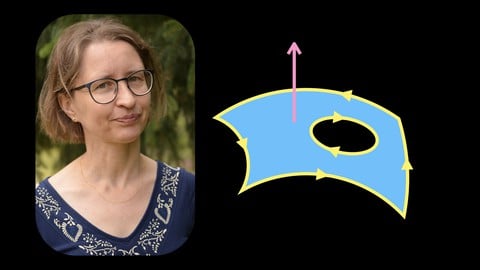
- Green's, Stokes' and Gauss' theorems.
- Gradient, curl and divergence.
- Surfaces as graphs of functions of two variables and parametric surfaces; normal vectors and orientation of surfaces; boundary of a surface.
- Five methods of computing line integrals of vector fields and four methods of computing surface integrals of vector fields (flux integrals).
 Course Description
Calculus 3 (multivariable calculus), part 2 of 2
Towards and through the vector fields, part 2 of 2: Integrals and vector calculus
[None of our courses are produced using AI; they are all real-human products.]
(Chapter numbers in Robert A. Adams, Christopher Essex: Calculus, a complete course. 8th or 9th edition.)
C4: Multiple integrals (Chapter 14)
S1. Introduction to the course
S2. Repetition (Riemann integrals, sets in the plane, curves)
S3. Double integrals
You will learn: compute double integrals on APR (axis-parallel rectangles) by iteration of single integrals; x-simple and y-simple domains; iteration of double integrals (Fubini's theorem).
S4. Change of variables in double integrals
You will learn: compute double integrals via variable substitution (mainly to polar coordinates).
S5. Improper integrals
You will learn: motivate if an improper integral is convergent or divergent; use the mean-value theorem for double integrals in order to compute the mean value for a two-variable function on a compact connected set.
S6. Triple integrals
S7. Change of variables in triple integrals
You will learn: compute triple integrals by Fubini's theorem or by variable substitution to spherical or cylindrical coordinates; compute the Jacobian for various kinds of change of variables.
S8. Applications of multiple integrals such as mass, surface area, mass centre.
You will learn: apply multiple integrals for various aims.
C5: Vector fields (Chapter15)
S9. Vector fields
S10. Conservative vector fields
You will learn: about vector fields in the plane and in the space; conservative vector fields; use the necessary condition for a vector field to be conservative; compute potential functions for conservative vector fields.
S11. Line integrals of functions
S12. Line integral of vector fields
You will learn: calculate both kinds of line integrals (the ones of functions, and the ones of vector fields) and use them for computations of mass, arc length, work; three methods for computation of line integrals of vector fields.
S13. Surfaces
You will learn: understand surfaces described as graphs to two-variable functions f:R^2-->R and as parametric surfaces, being graphs of r:R^2-->R^3; determine whether a surface is closed and determine surfaces' boundary; determine normal vector to surfaces.
S14. Surface integrals
You will learn: calculate surface integrals of scalar functions and use them for computation of mass and area.
S15. Oriented surfaces and flux integrals
You will learn: determine orientation of a surface; determine normal vector field; choose orientation of a surface which agrees with orientation of the surface's boundary; calculate flux integrals and use them for computation of the flux of a vector field across a surface.
C6: Vector calculus (Chapter16: 16.1--16.5)
S16. Gradient, divergence and curl, and some identities involving them; irrotational and solenoidal vector fields (Ch. 16.1--2)
S17. Green's theorem in the plane (Ch. 16.3)
S18. Gauss' theorem (Divergence Theorem) in 3-space (Ch. 16.4)
S19. Stokes' theorem (Ch. 16.5)
S20. Wrap-up Multivariable calculus / Calculus 3, part 2 of 2.
You will learn: define and compute curl and divergence of (two- and three-dimensional) vector fields and proof some basic formulas involving gradient, divergence and curl; apply Green's, Gauss's and Stokes's theorems, estimate when it is possible (and convenient) to apply these theorems.
Make sure that you check with your professor what parts of the course you will need for your final exam. Such things vary from country to country, from university to university, and they can even vary from year to year at the same university.
A detailed description of the content of the course, with all the 200 videos and their titles, and with the texts of all the 152 problems solved during this course, is presented in the resource file
"001 Outline_Calculus3_part2.pdf" under Video 1 ("Introduction to the course"). This content is also presented in Video 1.

 Udemy Discount
The discount is applied through our link. Open the course from here and Udemy's current promotional price is applied at checkout on most courses, no code to type.
Some courses are excluded from Udemy's promotions. If the price does not drop, clear your browser cookies and use the button again.
Instructor Details

- 4.9 Rating
 188 Reviews
Hania Uscka-Wehlou
I am a multilingual mathematician with a passion for mathematics education. I always try to find the simplest possible explanations for mathematical concepts and theories, with illustrations whenever possible, and with geometrical motivations.
I worked as a senior lecturer in mathematics at Uppsala University (from August 2017 to August 2019) and at Mälardalen University (from August 2019 to May 2021) in Sweden, but I terminated my permanent employment to be able to create courses for Udemy full-time.
I am originally from Poland where I studied theoretical mathematics and got pedagogical qualifications at the Copernicus University in Toruń (1992-1997). Before that, I enjoyed a very rigorous mathematical education in a mathematical class in high school "Liceum IV" in Toruń, which gave me a very solid foundation for everything else I have learned and taught later.
In my courses I teach various branches of university mathematics that I have learned from absolutely excellent lectures of my dear professors from Toruń: Mirosław Uscki (b.1946), Zbigniew Bobiński (b.1940), Paweł Jarek (1933-2013), and Stanisław Balcerzyk (1932-2005).
My PhD thesis (2009) was at Uppsala University in Sweden, with the title: "Digital Lines, Sturmian Words, and Continued Fractions".
 More courses by Hania Uscka-Wehlou
Calculus 3 (multivariable calculus), part 1 of 2 (2026)
4.8 (444 Reviews)
 Provider: Udemy
 Time: 47.9h
$79.99
Calculus 1, part 1 of 2: Limits and continuity (2026)
4.7 (291 Reviews)
- Provider: Udemy
- Time: 60h
$19.99

More Teaching & Academics courses
GMAT Focus | Quantitative| Master Math Course | 2026 Updated
5.0 (854 Reviews)
- Provider: Udemy
- Time: 55.3h
$11.99


Speed Reading MACHINE 5.1: How To Read 307 Books In 2026
4.9 (1,386 Reviews)
- Provider: Udemy
- Time: 7.2h
$12.99
GRE Quantitative Prep | Master Math Course | 2026 Updated
4.9 (980 Reviews)
- Provider: Udemy
- Time: 59h
$10.99
 Reviews

By José Miguel Fernández on 12/5/2022
Very good course!!. So far I've completed 90% of the content and I've learned a lot from it. The course itself is very well structured and the instructor gives cristal-clear explanations in every chapter, with lots of examples done by her and some others type try-yourself. I have 35 years of experience working as an engineer and I have not needed to solve any integral in my professional life, nor the simplest one. But I like maths from my years on college, that's the reason for me to choose to follow this course. I would like to thank Ms. Uscka-Wehlou for her effort in convey us clear explanations. I wish she could read this.
By Anthony Makibela on 5/21/2022
Excellent course. The instructor has a comprehensive coverage of the subject matter.
By David Leo on 1/17/2022
I think this course is great. Top quality production, engagingly delivered in a comfortable setting that is perfectly matched to the content.
By J M on 5/6/2021
This course is fantastic. It is easily worth 2–3x the asking price. The lecturer and editor take care to present concepts in an understandable way. The material is typeset well and utilizes color effectively. In addition to the extensive examples and proofs, the authors provide further notes on the technical/rigorous details for those who need them. This Udemy course has greatly enhanced my university class on the same topic. Thank you to the authors. Your excellent content has given me confidence for my exams.
By Damian Karwowski on 3/28/2021
Great course, very well structured topic-wise. Concepts are explained in a clear and detailed way, using all the right tools to make online learning efficient. There is a good balance of theory and practice, and lots of examples with step-by-step solutions. Also approachable if you feel like you could do with a recap of some topics before going into multivariable/vector calculus.
By Tetyana Mamchych on 3/26/2021
I have been teaching university mathematics in applications for many years. Hania's course is impressive. It lays out the technical concepts clearly and systematically. It illustrates ideas with carefully chosen examples. The large number of solved problems not only helps follow the theory but also effectively prepares for any standard exam in the subject.
By Christer Oscar Kiselman on 3/23/2021
This course is of the utmost quality in all respects. First of all the global organization of the topics. It is very well done and enables the student to rapidly grasp the subjects treated. Next the presentation of the various parts, which means that a student who do not need to study everything can make a well-based choice. Third, the presentation is perfect in all its details. And there is indeed a lot to think about in such a course, since it is rather difficult. The contents is very rich and well chosen---Hania has performed a highly non-trivial task. Finally, the language, the tone in addressing the students, is fine and most friendly.
By Maciej Kowalkowski on 3/21/2021
Excellent course! Plenty of solved problems, which are very easy to find in a very detailed list. Colourful illustrations not only make the concepts easier to understand, but also make the movies nicer to watch. The teacher's pronunciation is very clear: important for us who have English as second language. I appreciate it that she doesn't speak too quickly and that she explains every step. This makes this very hard maths course possible to learn.
By Andrzej Perzanowski on 3/18/2021
A fantastic and thorough series. It is exactly what I needed to continue to learn Calculus! All concepts are clearly explained and there are many worked out examples that are easy to follow. I really like that the videos provide intuition and motivation for the topics that are being discussed. The quality of the sound and the recording is great.
By Richard Bonner on 3/18/2021
Another excellent course from Hania. The quality of exposition does not get better. The devil is in the details, they say, and Hania again proves them right: work out the details, and things fall into place. The material is classical, central for physics, engineering, and many branches of applied mathematics. But it is technical, hard to assimilate in standard classroom setting. Hania's course offers a neat way out, not only effective, but also, I think, enjoyable.
 Quality Score
No CourseDuck member has rated this course yet. Taken it? Give each part a thumbs up or down.
Overall Score : 98 / 100
- Video Duration:
 44.5h
44.5h - Price: $74.99
- Provider: Udemy
- Updated:
 September 2026
 - Level:
 All Levels
 - Language:
 English
 - Certificate:
 Yes
Yes
30-day money-back guarantee on most paid courses
Udemy Coupon Price Tracker
