
 Web Development
 Python
 SQL
SQL JavaScript
 Data Science
 Artificial Intelligence
 IT & Software
 IT Certifications
 Hacking
 Arduino
 AWS
AWS 3D Modeling
 Graphic Design
 Photoshop
 Drawing
 Digital Painting
 UX Design
 Business
 Data Analysis
 Communication Skills
 Project Management
 Leadership & Management
 E-Commerce
 Digital Marketing
 Social Media Marketing
 Marketing
 SEO
SEO Google Analytics
 Branding
 Office Productivity
 Excel
Excel Finance & Accounting
 Bitcoin
 Video Editing & Animation
 Photography
 Adobe Premier Pro
 Adobe Lightroom
 Personal Development
 Health & Fitness
 Music
Music Guitar
 Teaching & Academics
 Language Learning
 Engineering
 Lifestyle
Microcontrollers and the C Programming Language (MSP430) (Udemy.com)
Create C programs for a microcontroller using inputs/outputs, timers, analog-to-digital converters, comm ports, and LCD.
Created by: Mark M. Budnik
Last updated May 2020
Our take
Based on the ratings of 4,454 students, a sample of their written reviews and the syllabus, as the course stood in May 2020. No course pays to be reviewed.
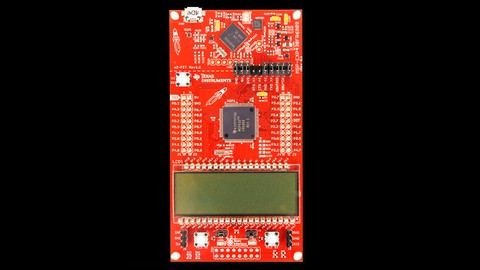
Mark Budnik is a university engineering professor, and this is a lab-based introduction to embedded C on the Texas Instruments MSP430. It starts with binary numbers and digital logic, then moves through loops, button inputs, timers, interrupts, low power modes, serial communication, analog-to-digital converters and an LCD, and ends with a final project. The syllabus shows 115 lectures in 18 sections, and about 98,000 students have signed up. It is aimed at people new to microcontrollers or C, but the labs assume a specific MSP430 board, and Section 1 explains how to get one.
Reviewers like the format. Videos are very short, and the real content sits in PDF handouts packed with example code and step-by-step explanations. One student called it an excellent manual for beginners, and another said it was the best MSP430 material they had found. The professor is described as speaking well and explaining clearly. The complaints are fair ones. One would rather have lectures than PDFs, another felt left to figure out the next steps alone with the chip manual, and a third asked for notes on printing to the console while debugging. A recent reviewer also disliked loud ads in the videos.
About 86 percent of the 4,454 ratings are four or five stars, with a 4.3 average. The course was last updated in May 2020, so the tools may have moved on a bit since. It is free, which makes the hardware the only real cost. Anyone who wants to learn by building should give it a go. Anyone who needs a lecturer talking through every concept will probably be happier elsewhere.
Pros
- Short videos with the real content in PDF handouts full of example code
- Covers timers, interrupts, low power modes, serial, ADC and LCD in one course
- Starts from binary and digital logic, so true beginners can follow along
- Free, with a final project to tie the labs together
Cons
- Needs a specific MSP430 board, so it is not really a watch-only course
- Heavy on PDFs; one student wanted proper video lectures instead
- Last updated May 2020, and little guidance on using the TI manuals
This course is by far the best I have found so far. Everything that I missed on the previous course material I have used is clearly and methodically explained.
Beginners to C and microcontrollers, if they own the MSP430 board and can work through PDFs alone.
 What you will learn
- Program microcontrollers with the C programming language.
- Use timer peripherals
- Use communication peripherals
- Use analog-to-digital converter peripherals
- Use a liquid crystal display (LCD)
- Use the MSP430 to develop embedded systems
Course content
18 sections · 115 lectures · 32 hours of video 14 quizzes, 2 articles
- 1How Do I Get Started? 10 free previews11 lectures · 1 quiz · 18 min
- 2Binary Numbers and Digital Logic 11 free previews11 lectures · 1 quiz · 5 min
- 3What's Inside of a Microcontroller 5 free previews6 lectures · 1 quiz · 22 min
- 4Loops in the C Programming Language13 lectures · 1 quiz · 9 min
- 5Digital Inputs, the P1.1 Button, and the IF Statement12 lectures · 1 quiz · 8 min
- 6Introduction to Timer Peripherals3 lectures · 1 quiz · 7 min
- 7Introduction to the Watchdog Timer Peripheral4 lectures · 1 quiz · 5 min
- 8Introduction to the General Purpose Timer6 lectures · 1 quiz · 2 min
- 9Advanced Features of General Purpose Timers2 lectures · 1 quiz · 1 min
- 10Using Functions to Improve Your Microcontroller Program2 lectures · 1 quiz · 4 min
- 11Introduction to Interrupt Service Routines7 lectures · 1 quiz · 3 min
- 12Introduction to Low Power Modes5 lectures · 1 quiz · 5 min
- 13Interrupt Service Routines for Digital Inputs2 lectures · 2 min
- 14Serial Communication Interfaces6 lectures · 1 quiz · 5 min
- 15Analog-to-Digital Converters6 lectures · 1 quiz · 7 min
- 16Introduction to the Liquid Crystal Display (LCD)10 lectures · 2 min
- 17Final Project2 lectures · 1 min
- 18Wrap Up7 lectures · 1 min
Who it is for
The instructor says it suits
- This course is meant for individuals who are not familiar with microcontrollers, the MSP430, and/or the C programming language.
- For more experienced individuals, the course will also expedite the learning curve for the Texas Instruments MSP430 and Code Composer Studio integrated development environment.
What you need before you start
- Information about the laboratory kit and the instructions for downloading the software will be provided in Section 1.
 Quality Score
Overall Score : 86 / 100
 Course Description
The course is laboratory based. Almost every lecture and section of the course leads directly to a hands-on laboratory assignment. The more practice you get using the “real world" Texas Instruments MSP430 hardware and software the more proficient you will be.
The course does not waste your time. From the very beginning, we jump right in to your first laboratory assignment – Let's Get Started.
The course is modular in nature. Are you new to the world of microcontrollers? Great! Start at the beginning, and we'll teach you everything you need to know. Do you have some background in microcontrollers but want to learn more? Fantastic! You can pick and choose the modules that you need.
The course is packed with information. From the beginnings of the C programming language to advanced microcontroller peripherals, the course teaches you all of the building blocks you would need to build your own electronic systems.
We use lots and lots of examples. We take you step-by-step through the lessons – each time providing sample code and documentation to make sure you are supported through the course.
We are here to help. We are educators with a singular focus of providing a meaningful experience for our students. And, while we cannot do the work for you, we are willing to work WITH you help you succeed.

 Udemy Discount
The discount is applied through our link. Open the course from here and Udemy's current promotional price is applied at checkout on most courses, no code to type.
Some courses are excluded from Udemy's promotions. If the price does not drop, clear your browser cookies and use the button again.
Instructor Details

- 4.3 Rating
 4,454 Reviews
Mark M. Budnik
Mark M. Budnik is the Paul H. Brandt Professor of Engineering at Valparaiso University. He received his bachelor of science degree in electrical engineering from the University of Illinois and his master of science and doctoral degrees in electrical engineering from Purdue University.
Prior to joining the faculty at Valparaiso University in 2006, Mark worked in the semiconductor industry, culminating as a Staff Engineer and the Director of White Goods and Motor Control at Hitachi Semiconductor. In these roles, he had a unique opportunity to work closely with a diverse customer base to identify and establish a number of best practices in embedded systems education.
In his career, he received multiple educational awards from academia and industry including ST Microelectronics, National Semiconductor, Hitachi Semiconductor, Valparaiso University, and the American Society for Engineering Education (ASEE). Most recently, Mark was an ASEE Section Outstanding Teacher of the Year and a finalist for the 2015 ASEE National Outstanding Teaching Award.
Mark is the author of more than fifty book chapters, journal articles, and conference proceedings and the recipient of five best paper/presentation awards. He is a Senior Member of the IEEE and a Fellow of the International Symposium on Quality Electronic Design.
 More C courses
C Programming Step by Step - Complete Tutorial For Beginners (2020)
4.7 (3,411 Reviews)
 Provider: Udemy
 Time: 17.3h
$84.99
Mastering Data Structures & Algorithms using C and C++ (2025)
4.6 (60,478 Reviews)
- Provider: Udemy
- Time: 76.1h
$149.99


 Reviews

By Jason Abernathy on 7/19/2026
Commercials in every video and the volume of the commercial is very loud.
By Srimathi on 7/9/2026
I n this course I learned about many concepts such as number system , digital logic, microcontrolers, C programing.Thank you for giving this course to gain knowledge.
By Charles Belford on 4/11/2026
Course is really amazing, but requires some extra hardware to be able to properly take it. I got the MSP430 the course requires, and I think it's really worth the time. I like the course format, with very very short videos, and all the meat of the course are on the documents, no wasted time watching pointless long videos
By Patrick Wetherill on 1/22/2020
The course was helped me get started with microcontrollers, so I would call it a success. It was great to have such a large overview of projects and subjects in one, organized place, focused on a modern, relevant MCU. I think the course lacked a little in its use of the MCU manual and Texas Instrument resources however, as the user if left to figure out the next steps alone. I recommend the course and haven't seen anything close to it. Does take some focus and patience to work through everything, its primarily project based independent learning.
By William Mutasa on 3/23/2019
The course has set up a new level for me to think algorithmically and solve programming problems efficiently at my workplace. The course content is precise and the lecturer is very knowledgeable, engaging and kept me interested in the material. The lecturer explains very well and tried to break it down so that you do not miss all the minutiae details. I enjoyed!!!!
By Muralikrishnan V on 12/19/2018
Microprocessor basics should be covered little more in detail. JTAG is must in embedded C courses as everybody in the industry is using it. Please update the course with JTAG.
By JR Adams on 1/15/2018
Finally a course that has allowed me to visibly understand the binary code, its text representations, its "modus operandi" in the real world. A short and precise course which in my case, I have to revisit more than once and will do so as soon as I get my hands on some of the Texas Instruments launchpads. A must for anyone who wants to learn about the know-how of microcontrollers and how they are applied to the real world.
By Reinhard Pontius on 6/23/2017
One of my favourite programming courses. It is perfectly organized. All possible problems are intercepted and illustrated prior you get roped into it. The choosen microcontroller board is very suitable for this course. I liked the combination of the short videos and the very good examples/exercises.
By Carlos Roque on 4/30/2017
I have a very limited knowledge about programming languages and I am very interested to learn C language. This course made it possible for me to learn a lot and removed the cobwebs in my mind. Questions in my mind got cleared studying this course. Readingmaterials are very clear. I would highly recommend this especially if you are a beginner like me.
By Alberto Perri on 2/5/2017
The Watchdog concept and how to use it was clearly explained Timers and their modes for PWM crealy expalined Timers with interrupts clearly explained Single timer for multiple frequencies does not make clear how the #pragma vector=TIMER0_A0_VECTOR is associated wtih P9 and how the #pragma vector=TIMER0_A1_VECTOR is associated with P1
Fantastic course and very patient and knowledgeable instructor. Replies are very prompt and instructions/handout and lectures are step by step with comprehensive and detailed step by step explanation leaving nothing to imagination
Absolutely "must have" course for any beginner in the Embedded Systems world. It is a great introduction especially for people/students in my country: Poland. Unfortunately there is no way to learn it deeply in the polish Universities, so if you want to be Embedded Developer you need to do it on your own. That is why, it is a must have for everybody.
I really recommend this course and encourage to get into this.
Thank You very much for this, I hope it will really help me to become the Embedded Developer.
- Video Duration:
 31.9h
31.9h - Price: Free
- Provider: Udemy
- Updated:
 May 2020
 - Level:
 All Levels
 - Language:
 English
 - Certificate:
 No
No - Lectures:115 in 18 sections
- Practice:14 quizzes
- Students:98,300
- Subtitles:10 languages
Udemy Coupon Price Tracker
