
 Web Development
 Data Science
 Python
 SQL
 JavaScript
 Artificial Intelligence
 IT & Software
 IT Certifications
 Hacking
 AWS
 Arduino
 DevOps
 3D Modeling
 Graphic Design
 Photoshop
 Drawing
 Digital Painting
 UX Design
 Business
 Data Analysis
 Communication Skills
 Project Management
 Leadership & Management
 Human Resources
 Digital Marketing
 Social Media Marketing
 Marketing
 SEO
 Google Analytics
 Branding
 Excel
 Office Productivity
 SAP
 PowerPoint
 Microsoft Access
 SharePoint
 Finance & Accounting
 Trading & Investing
 Accounting
 Bitcoin
 Personal Finance
 Video Editing & Animation
 Photography
 Adobe Premier Pro
 Adobe Lightroom
 Personal Development
 Productivity
 Career Development
 Life Coaching
 Health & Fitness
 Meditation & Mindfulness
 Yoga
 Music
 Music Production
 Guitar
 Piano
 Singing
 Language Learning
 Teaching & Academics
 Engineering
 Math
 Lifestyle
CCNP ENTERPRISE {2025} ENCOR+ENARSI | 120+ Hr NetworkJourney (Udemy.com)
* Covers ENARSI+ENCOR * Excellent GNS3 Labs * Everything To Get CCNP Enterprise Certification * Massive Lab Topology
Created by: Network Journey
Last updated February 2025
 What you will learn
- NEW CISCO CCNP ENTERPRISE
- NEW CISCO CCIE ENTERPRISE
- CCNP ENCOR
- CCNP ENARSI
- CCNP CCIE - ENCOR
- CCNP CONCENTRATION - ENARSI
- CCNP ENCOR 350-401
- CCNP ENARSI 300-410
- CCIE WRITTEN (CCNP ENCOR)
How it compares
Against the other 165 rated Udemy courses in Networking on CourseDuck:
- Rating4.1 out of 5higher than 6% of them
- Reviews153#133 of 166 by number of reviews
- Length95 hourslonger than 100% of them
- Last updatedFebruary 2025more recently than 62% of them
 Course Description
This is a full course for CCNP ENTERPRISE (ENCOR +ENARSI) | Trainer Sagar Dhawan
(passing will also make you CCIE Written certified as per 2025 Cisco's restructuring program)
This course covers both ENARSI (350-401) + ENCOR (300-410)
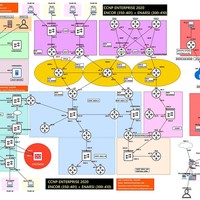
GNS3/EVENG Massive Lab Topology for Practicing
Sample Workbook of our 100+ Lab Workbook
Real time Production Scenerios
Read my Linkedin testimonials from genuine Student having more than 10+ years of Networking Experience -
sagar-dhawan-network-journey
This exam tests a candidate's knowledge of implementing core enterprise network technologies including
Dual stack (IPv4 and IPv6) architecture,
Virtualization,
Infrastructure (L2 and L3)
Network assurance,
Security
Network Automation.
WHO IS TARGET GROUP ?
Anyone who wants to prepare for the CCNP Enterprise certification exams
Anyone who wants to learn routing at professional level
CCNP ENTERPRISE ENCOR 350-401 SYLLABUS BLUEPRINT:
1.1 Explain the different design principles used in an enterprise network
1.1.a Enterprise network design such as Tier 2, Tier 3, and Fabric Capacity planning
1.1.b High availability techniques such as redundancy, FHRP, and SSO
1.2 Analyze design principles of a WLAN deployment
1.2.a Wireless deployment models (centralized, distributed, controller-less, controller based, cloud, remote branch)
1.2.b Location services in a WLAN design
1.3 Differentiate between on-premises and cloud infrastructure deployments
1.4 Explain the working principles of the Cisco SD-WAN solution
1.4.a SD-WAN control and data planes elements
1.4.b Traditional WAN and SD-WAN solutions
1.5 Explain the working principles of the Cisco SD-Access solution
1.5.a SD-Access control and data planes elements
1.5.b Traditional campus interoperating with SD-Access
1.6 Describe concepts of wired and wireless QoS
1.6.a QoS components
1.6.b QoS policy
1.7 Differentiate hardware and software switching mechanisms
1.7.a Process and CEF
1.7.b MAC address table and TCAM
1.7.c FIB vs. RIB
2.0 Virtualization
10%
2.1 Describe device virtualization technologies
2.1.a Hypervisor type 1 and 2
2.1.b Virtual machine
2.1.c Virtual switching
2.2 Configure and verify data path virtualization technologies
2.2.a VRF
2.2.b GRE and IPsec tunneling
2.3 Describe network virtualization concepts
2.3.a LISP
2.3.b VXLAN
3.0 Infrastructure
30%
3.1 Layer 2
3.1.a Troubleshoot static and dynamic 802.1q trunking protocols
3.1.b Troubleshoot static and dynamic EtherChannels
3.1.c Configure and verify common Spanning Tree Protocols (RSTP and MST)
3.2 Layer 3
3.2.a Compare routing concepts of EIGRP and OSPF (advanced distance vector vs. linked state, load balancing, path selection, path operations, metrics)
3.2.b Configure and verify simple OSPF environments, including multiple normal areas, summarization, and filtering (neighbor adjacency, point-to-point and broadcast network types, and passive interface)
3.2.c Configure and verify eBGP between directly connected neighbors (best path selection algorithm and neighbor relationships)
3.3 Wireless
3.3.a Describe Layer 1 concepts, such as RF power, RSSI, SNR, interference noise, band and channels, and wireless client devices capabilities
3.3.b Describe AP modes and antenna types
3.3.c Describe access point discovery and join process (discovery algorithms, WLC selection process)
3.3.d Describe the main principles and use cases for Layer 2 and Layer 3 roaming
3.3.e Troubleshoot WLAN configuration and wireless client connectivity issues
3.4 IP Services
3.4.a Describe Network Time Protocol (NTP)
3.4.b Configure and verify NAT/PAT
3.4.c Configure first hop redundancy protocols, such as HSRP and VRRP
3.4.d Describe multicast protocols, such as PIM and IGMP v2/v3
4.0 Network Assurance
10%
4.1 Diagnose network problems using tools such as debugs, conditional debugs, trace route, ping, SNMP, and syslog
4.2 Configure and verify device monitoring using syslog for remote logging
4.3 Configure and verify NetFlow and Flexible NetFlow
4.4 Configure and verify SPAN/RSPAN/ERSPAN
4.5 Configure and verify IPSLA
4.6 Describe Cisco DNA Center workflows to apply network configuration, monitoring, and management
4.7 Configure and verify NETCONF and RESTCONF
5.0 Security
20%
5.1 Configure and verify device access control
5.1.a Lines and password protection
5.1.b Authentication and authorization using AAA
5.2 Configure and verify infrastructure security features
5.2.a ACLs
5.2.b CoPP
5.3 Describe REST API security
5.4 Configure and verify wireless security features
5.4.a EAP
5.4.b WebAuth
5.4.c PSK
5.5 Describe the components of network security design
5.5.a Threat defense
5.5.b Endpoint security
5.5.c Next-generation firewall
5.5.d TrustSec, MACsec
5.5.e Network access control with 802.1X, MAB, and WebAuth
6.0 Automation
15%
6.1 Interpret basic Python components and scripts
6.2 Construct valid JSON encoded file
6.3 Describe the high-level principles and benefits of a data modeling language, such as YANG
6.4 Describe APIs for Cisco DNA Center and vManage
6.5 Interpret REST API response codes and results in payload using Cisco DNA Center and RESTCONF
6.6 Construct EEM applet to automate configuration, troubleshooting, or data collection
6.7 Compare agent vs. agentless orchestration tools, such as Chef, Puppet, Ansible, and SaltStack
CCNP ENTERPRISE ENARSI 300-410 SYLLABUS BLUEPRINT:
1.1 Troubleshoot administrative distance (all routing protocols)

 Udemy Discount
The discount is applied through our link. Open the course from here and Udemy's current promotional price is applied at checkout on most courses, no code to type.
Some courses are excluded from Udemy's promotions. If the price does not drop, clear your browser cookies and use the button again.
Instructor Details
- 4.1 Rating
 153 Reviews
Network Journey
Hello Network Engineers,
I am presenting this course to you so that it helps you to achieve your dream and Cisco Certification at very first attempt.
I have tried to cover as much as scenario's here to help you troubleshoot the Network in Live production networks.
I have used GNS3, EVE-NG and also packet-tracer (sometimes) to demonstrate most of the topic. In some areas the packet level has been demonstrated with the help of Wireshark as well.
Regards
Dhawan Sagar
Senior Trainer - Networking
 More courses by Network Journey

NEW CISCO CCNA 200-301 (Complete Full Series) Training -2020
4.5 (304 Reviews)
 Provider: Udemy
 Time: 88.3h
$59.99
More Networking courses
The Ultimate Cisco CCNA Packet Tracer Project (2024)
5.0 (210 Reviews)
- Provider: Udemy
- Time: 3.2h
$89.99

CCNA OSPF troubleshooting: Cisco CCNA and ICND2 exam prep (2020)
4.9 (424 Reviews)
- Provider: Udemy
- Time: 2h
Free

The World of Computer Networking. Your CCNA starts here (2026)
4.8 (1,993 Reviews)
- Provider: Udemy
- Time: 15.7h
$84.99

OSPF for the Real World - From Zero to Hero (2023)
4.8 (1,173 Reviews)
- Provider: Udemy
- Time: 6.2h
$84.99


CCNA BGP configuration and troubleshooting: Cisco CCNA prep (2023)
4.8 (995 Reviews)
- Provider: Udemy
- Time: 54 mins
Free
 Reviews

By Dinesh Vyas on 2/7/2026
Very good way explanation, my till now my concept are clear. Thank you so much.
By Norberth Rodrigues on 9/10/2025
Excellent teaching but Sagar D., have you shared the PDF that you discussed in this UDEMY video course? COULD YOU PLEASE SHARE THE PDF if not? Thanks.
By Shankar Jothi on 8/27/2025
good introduction to encore concepts.
By HERMENEGILDO PEREIRA on 5/20/2025
Don't buy it and don't believe what he says in the beginning. It's just a lie he does not provide anything he says on the video. PowerPoint presentation only. Look for Kevin Wallace.
By Peter Opute on 6/13/2024
The theoretical aspect is well delivered. However, I am not satisfied with it so far because it felt short of my expectations: mainly packed with theories, no practical lessons/hands-on lab
By Mohammed Waquar Ahmed on 5/10/2024
I found it very interesting
By Cory McCall on 3/27/2024
So far the instructor has covered many of the items for the exam.
By Mohammed Kaladiyil on 2/22/2023
I would recommend not jumping over all the topics so randomly. I understand you have beginners listening to this class hence kindly avoid that and take the class in a structured format.
By Ivano L. T. Mendes on 2/14/2023
This is a Great course , the instructor is very skilled, I recommend it to both beginners and people with experience, becouse it covers all CCNP ENCOR and ENARS topics.
By Renan Fernandes Onofre on 2/10/2023
Great course , Good explanation, speak slow is good for new students , like me non native english speakers , thanks im from brazil and understand well many lessons
 Quality Score
No CourseDuck member has rated this course yet. Taken it? Give each part a thumbs up or down.
Overall Score : 82 / 100

- Video Duration:
 95h
- Price: $59.99
- Provider: Udemy
- Updated:
 February 2025
- Level:
 All Levels
- Language:
 English
- Certificate:
 Yes
30-day money-back guarantee on most paid courses
Udemy Coupon Price Tracker
