
 Web Development
 Data Science
 Python
 SQL
 JavaScript
 Artificial Intelligence
 IT & Software
 IT Certifications
 Hacking
 AWS
 Arduino
 DevOps
 3D Modeling
 Graphic Design
 Photoshop
 Drawing
 Digital Painting
 UX Design
 Business
 Data Analysis
 Communication Skills
 Project Management
 Leadership & Management
 Human Resources
 Digital Marketing
 Social Media Marketing
 Marketing
 SEO
 Google Analytics
 Branding
 Excel
 Office Productivity
 SAP
 PowerPoint
 Microsoft Access
 SharePoint
 Finance & Accounting
 Trading & Investing
 Accounting
 Bitcoin
 Personal Finance
 Video Editing & Animation
 Photography
 Adobe Premier Pro
 Adobe Lightroom
 Personal Development
 Productivity
 Career Development
 Life Coaching
 Health & Fitness
 Meditation & Mindfulness
 Yoga
 Music
 Music Production
 Guitar
 Piano
 Singing
 Language Learning
 Teaching & Academics
 Engineering
 Math
 Lifestyle
Early Childhood Education - Numeracy and Math Development (Udemy.com)
strategies for early childhood educators and parents to support children's math learning
Created by: Mandy Lam
Last updated January 2023
 What you will learn
- Create learning contexts that allow children to use their innate numeracy skills
- Facilitate children's learning of numbers and quantities through play and other daily activities
- Use principles of Universal Design for Learning to identify children's interests, curiosities, and inquiries in numeracy skills development
- Use effective communication techniques to facilitate numeracy learning
How it compares
Against the other 503 rated Udemy courses in Teaching & Academics on CourseDuck:
- Rating4.6 out of 5higher than 58% of them
- Reviews246#340 of 504 by number of reviews
- Length1.1 hoursshorter than 89% of them
- Last updatedJanuary 2023earlier than 54% of them
 Course Description
Helping children develop their early childhood numeracy skills can have a profound impact on their future math skills during school years. That is because these skills are part of the foundation of math learning including logical reasoning, problem solving, and observing patterns. This course aims to offer you strategies to support your child’s early childhood numeracy development as your child’s caregiver or first teacher.
There are many benefits to using these strategies. The first and foremost benefit is that you can make learning not feel like learning at all for both you and your child. These strategies will help you integrate numeracy learning seamlessly into your everyday interactions, activities, and routines, and make numeracy learning more fun and enjoyable for both you and your child.
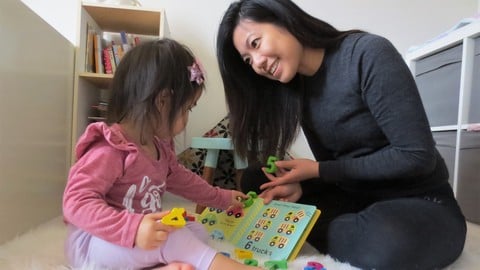
By completing this course, you will learn to facilitate play-based learning at home or in an early childhood education environment. You will gain skills in observing children's interest and curiosities, which would help you guide children's learning.
Whether your role is a parent, caregiver, or early childhood educator, the strategies and theories you learn will allow your child could benefit from building a strong foundation in numeracy skills and cultivating their confidence to succeed in math during their future school years.
Contents and Overview
This course contains 16 lectures and 60 minutes of content. It is designed for anyone who is a caregiver or educator of children in their early childhood years, which is from birth to the age of 8.
The following are the key topics in this course:
1) Stages of Early Numeracy Development
2) Make Numeracy Part of Everyday Life
3) Communication Techniques
4) Teaching and Learning Numeracy for Children
5) Numeracy Development through Storytelling
6) Do-It-Yourself Math Toys and Activities
In this course, you will first learn about the stages of early numeracy development, which will provide you with an overview of a child’s developmental abilities and milestones. This will give you the foundation to understand the stages your child is going through and to choose the appropriate strategies that could support and enhance your child’s numeracy skill development. This will help you apply both age-appropriate and developmental stage-appropriate strategies to optimize children's learning. You will also learn about innate numeracy skills that children are born with. By understanding how children think and their cognitive ability in understanding numbers and quantities will help you see learning through the lens of children and become a better teacher.
Next, you will learn concrete strategies to infuse numeracy learning into your everyday life. These strategies will offer you ways to introduce, reinforce, and advance your child’s numeracy skills depending on the stage of development they are at. You will learn about various techniques and principles of learning to create learning contexts and play-based activities for your child. You will understand that for children, any environment or setting can become an opportunity for learning. You will also gain skills in navigating spontaneous learning moments that arise to facilitate impactful learning.
After that, you will learn ways to support your child’s numeracy development during their early school years. This course will show you strategies that will support your child’s learning of other numeracy-related skill sets in school, such as patterning, geometry, and measurements. Very often, parents and teachers focus heavily on numbers and operations when it comes to mathematics learning. The skill sets in patterning, geometry, and measurements are equally important and valuable. You will learn ways to build a strong foundation in mathematics for children.
And finally, you will learn to facilitate numeracy development through storytelling. Just as children have an innate ability to understand numbers and quantities, they also have an innate ability to understand language. They have an innate sense of wonder and curiosity that could be brought out through reading and listening to stories. Storybooks with a math focus are excellent resources. I will show you examples of Math Storybooks and how you can integrate them into early childhood numeracy development. Then I will discuss the research and theories behind the effectiveness of facilitating numeracy development through storytelling.
This course will end with examples of how you can create math toys and activities with children to optimize the learning experience for them. These examples and ideas will show you how to create and use concrete learning tools, which are extremely important for you to model mathematical ideas and make thinking visible as a facilitator of learning. For children, math toys are also tools that help them see patterns and relationships, make connections between the concrete and the abstract, remember how they solved a problem, test and confirm their logical reasoning, and communicate their ideas and reasoning to others.
Learning Outcomes
1) Create learning contexts that allow children to use their innate numeracy skills
2) Facilitate children's learning of numbers and quantities through play and other daily activities
3) Use principles of Universal Design for Learning to identify children’s interests, curiosities, and inquiries in numeracy skills development
4) Use effective communication techniques to facilitate numeracy learning

 Udemy Discount
The discount is applied through our link. Open the course from here and Udemy's current promotional price is applied at checkout on most courses, no code to type.
Some courses are excluded from Udemy's promotions. If the price does not drop, clear your browser cookies and use the button again.
Instructor Details

- 4.6 Rating
 246 Reviews
Mandy Lam
Mandy Lam is a college math professor in Toronto, Canada. With a Master of Education and more than 10 years of experience in teaching and supporting numeracy development, she is always implementing innovative ways to engage her students in the math classroom. At home, she is doing the same as a mom of a preschooler, who is curious and always ready to learn.
Mandy has been an active member in the community of education. She has been interviewed on TV and radio to discuss math education. She has also held workshops for parents and spoken at events that aim to empower young girls in science, technology, engineering, and mathematics. To share ideas more widely, she has written and published articles with the Ontario Society for Environmental Education, City Parent, and the Ontario Association for Mathematics Education’s Math Gazette. Her published articles include “Sprinkling Math Learning onto Everyday Life”, “Green Math – Environmental Education in the Mathematics Classroom”, and “Collaborative Learning – It’s More Than Divide and Conquer”. She has also written and self-published math-themed children’s books on Amazon Kindle.
Her passion and accomplishments in math education are highlighted by her M.Ed. Thesis in Education Prize and her nomination in the Teaching Excellence Award.
For more tips on early childhood math development, follow her Instagram on @mathstorytelling
 More Teaching & Academics courses

GMAT Focus | Quantitative| Master Math Course | 2026 Updated
5.0 (854 Reviews)
 Provider: Udemy
 Time: 55.3h
$11.99

Speed Reading MACHINE 5.1: How To Read 307 Books In 2026
4.9 (1,386 Reviews)
- Provider: Udemy
- Time: 7.2h
$12.99

GRE Quantitative Prep | Master Math Course | 2026 Updated
4.9 (980 Reviews)
- Provider: Udemy
- Time: 59h
$10.99

IELTS Pro: Reading | Writing | Listening | Speaking (2026)
4.9 (799 Reviews)
- Provider: Udemy
- Time: 30.4h
$10.99


 Reviews

By Maserole Mpyana on 9/30/2025
Children need to be taught and listened to at an early so that you can identify their struggles when it comes to reading
By Andre Titus on 9/28/2025
Absolutely great course! This is something I wish I watched 3 years ago. A must for every parent wanted to lay a good foundation at home
By Mindy Udall on 9/24/2025
Good examples, but I would like to see an actual interaction between child and adult with showing what the instructor is saying.
By Divya Gulati on 9/12/2025
It was a short and quick course that explained how kids learn numeracy and math skills in early years. It also shared strategies which can be applied by teachers and parents to facilitate learning in children.
By Susan Pamela Mac Donald on 2/21/2025
The facilitator clearly knows what she's talking about. Videos are the right length, good visuals are used and the presenter speaks clearly.
By Patricia Wee on 9/15/2024
Yes enjoyed the course. Easy to follow projects which makes learning fun and not much preparation work involved. Fun and meaningful to young learners.
By Nicole Bly on 1/6/2024
I was hoping it would have a bit more information for K-2 students, but it still gave me some good ideas.
By Victoria Charlotte Ali on 10/13/2022
Yes I've found it is teaching me precisely how young children learn, which is what I wanted to get from the course
By Malisa Punit on 5/7/2021
The use of visual aids are helpful to gain a literal sense of what you are talking about. I like the way you use your own examples about your child to relate to your audience. I do believe you could speak a little faster/ less robotic and more as if you are having a regular conversation about something you're passionate about.
By Kris Wong on 5/1/2021
The instructor is very knowledgeable on this topic. The resources and tips really help me as a parent. My preschooler loved the activities in course!
 Quality Score
No CourseDuck member has rated this course yet. Taken it? Give each part a thumbs up or down.
Overall Score : 92 / 100
- Video Duration:
 1.1h
- Price: $44.99
- Provider: Udemy
- Updated:
 January 2023
- Level:
 Beginner
- Language:
 English
- Certificate:
 Yes
30-day money-back guarantee on most paid courses
Udemy Coupon Price Tracker
