
 Web Development
 Data Science
 Python
 SQL
 JavaScript
 Artificial Intelligence
 IT & Software
 IT Certifications
 Hacking
 AWS
 Arduino
 DevOps
 3D Modeling
 Graphic Design
 Photoshop
 Drawing
 Digital Painting
 UX Design
 Business
 Data Analysis
 Communication Skills
 Project Management
 Leadership & Management
 Human Resources
 Digital Marketing
 Social Media Marketing
 Marketing
 SEO
 Google Analytics
 Branding
 Excel
 Office Productivity
 SAP
 PowerPoint
 Microsoft Access
 SharePoint
 Finance & Accounting
 Trading & Investing
 Accounting
 Bitcoin
 Personal Finance
 Video Editing & Animation
 Photography
 Adobe Premier Pro
 Adobe Lightroom
 Personal Development
 Productivity
 Career Development
 Life Coaching
 Health & Fitness
 Meditation & Mindfulness
 Yoga
 Music
 Music Production
 Guitar
 Piano
 Singing
 Language Learning
 Teaching & Academics
 Engineering
 Math
 Lifestyle
YOLO26 & The Legacy : 6 in 1 YOLO Masterclass 2026 (Udemy.com)
Build Real-World Computer Vision Projects using YOLOv7 YOLOv8 YOLOv9 YOLOv10 YOLO11 YOLO26: Detection, Tracking, AI Apps
Created by: Dr. Priyanto Hidayatullah
Last updated August 2026
 What you will learn
- How to run, from scratch, a YOLOv7, YOLOv8, YOLOv9, YOLOv10, YOLOv11 and YOLO26 program to detect 80 object classes in < 10 minutes
- How to install and train YOLOv7 YOLOv8 YOLOv9 YOLOv10 YOLO11 YOLO26 using Custom Dataset & perform Object Detection for image, video & Real-Time using Webcam
- Custom Object Detection, Instance Segmentation, Pose Estimation, Image Classification, Object Tracking + Real-World Projects
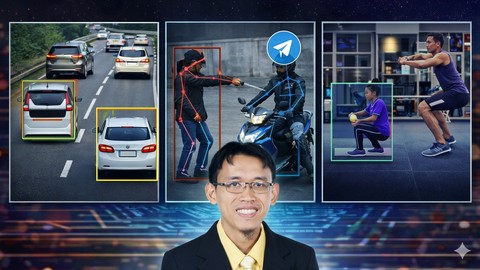
- Build 12 Real Projects: Vehicle Counter & Speed Estimation Web App, Suspicious Movement Detection + Telegram Notification, Smart Car Parking Lot System and more
- YOLOv7, YOLOv8, YOLOv9, YOLOv10, YOLO11, and YOLO26 architecture and how it really works
- How to find dataset
- Data annotation/labeling
- Automatic Dataset splitting
- How to train YOLO v7, YOLO v8, YOLO v9, YOLO v10, YOLO11, YOLO26 using custom dataset, transfer learning and resume training.
How it compares
Against the other 126 rated Udemy courses in Deep Learning on CourseDuck:
- Rating4.3 out of 5higher than 18% of them
- Reviews735#56 of 127 by number of reviews
- Length16.6 hourslonger than 73% of them
- Last updatedAugust 2026more recently than 91% of them
 Course Description
Want to build powerful AI systems that understand images and video?
In this course, you will master YOLO (You Only Look Once), one of the most popular object detection frameworks in Computer Vision and Deep Learning.
Learn how to build real AI applications using YOLOv7, YOLOv8, YOLOv9, YOLOv10, YOLOv11, and the latest YOLO26 (6 in 1 course). Train custom models, detect objects in real time, and run your systems on images, videos, and live webcams.
Everything is explained clearly and step-by-step, making it beginner-friendly.
What You’ll Be Able to Do
By following the tutorial, at the end of this course, you will be able to:
Run YOLO models from scratch and detect 80+ objects in minutes
Train your own models using custom datasets
Build real-time AI systems using webcam and video
Create real-world computer vision applications
Learn Only What Matters
You’ll understand the essentials without getting overwhelmed:
How YOLO evolved into the fastest detection system today
Core deep learning and CNN concepts (explained simply)
How every YOLO architectures actually work
Hands-On Skills You’ll Master
Dataset collection and annotation (LabelImg)
Automatic dataset splitting
Training with custom data and transfer learning
Monitoring performance with TensorBoard
Object detection, Instance segmentation, Object tracking, and Image classification
12 Real-World Projects That Make You Stand Out
These are not toy examples.
These are portfolio-ready systems you can showcase or monetize:
• Vehicle Counter & Speed Estimation Dashboard
• Smart Parking Detection System
• Suspicious Movement Detection with Telegram Alerts
• X-Ray Image Classification (Medical AI)
• Fitness AI: Squat Counter
• Pothole Segmentation for Smart Cities
Plus many more hands-on projects to strengthen your Computer Vision portfolio.
Why This Course Is Different
Covers 6 YOLO versions in one course
Focus on real applications, not just theory
Designed for portfolio, freelance, and job-ready skills
Beginner-friendly but powerful enough for advanced learners
If you want to master YOLO and build real AI vision systems, this course will guide you step-by-step.
Start building your own AI-powered Computer Vision applications today. Enroll now!

 Udemy Discount
The discount is applied through our link. Open the course from here and Udemy's current promotional price is applied at checkout on most courses, no code to type.
Some courses are excluded from Udemy's promotions. If the price does not drop, clear your browser cookies and use the button again.
Instructor Details

- 4.3 Rating
 735 Reviews
Dr. Priyanto Hidayatullah
Hello. My name is Priyanto Hidayatullah. I have 17+ years of experience in Computer Vision (CV) and 8+ years in Artificial Intelligence (AI), in teaching, researching, and doing projects.
I got my Ph.D in AI from Institut Teknologi Bandung Indonesia and graduated with distinction (Cum Laude). My dissertation is on applying AI to a computer vision problem. In my dissertation, I modified YOLO architecture which made it faster and more accurate. I use YOLO in my projects and research. So YOLO is my thing.
I received double degree masters in Computer Vision from Universite Jean Monnet France and the University of Eastern Finland. I have written several publications in reputable journals (Scopus Q1) and 6 books. Two of them are national best sellers because they are easy to understand. So, Computer Vision is my expertise.
I have designed my courses super carefully to be easy to follow even for beginners. I crafted every single course with the eagerness to share knowledge with others and happiness when my students understood.
 More Deep Learning courses
A deep understanding of deep learning (with Python intro) (2026)
4.8 (6,559 Reviews)
 Provider: Udemy
 Time: 57.3h
$109.99

Deep Learning Prerequisites: Logistic Regression in Python (2026)
4.8 (4,922 Reviews)
- Provider: Udemy
- Time: 6.9h
$109.99

Data Science: Transformers for Natural Language Processing (2026)
4.8 (3,034 Reviews)
- Provider: Udemy
- Time: 19.1h
$79.99

Complete Tensorflow 2 and Keras Deep Learning Bootcamp (2022)
4.7 (8,938 Reviews)
- Provider: Udemy
- Time: 19.2h
$16.99
Deep Learning: Advanced Computer Vision (GANs, SSD, +More!) (2026)
4.7 (7,132 Reviews)
- Provider: Udemy
- Time: 17.2h
$124.99
 Reviews

By Anonymized User on 7/9/2025
This is a good intro, maybe not quite the right fit for me. I have extensive programming experience. I didn't get much from the repeated "here's how you copy files in Windows" bits. Speeding up playback in those sections helped. Also, the description of YOLO architecture could have been more in-depth than just listing computational blocks. All that said, though, I like the course's thoroughness.
By Mamunur Rahman on 9/30/2024
Dr. Priyanto Hidayatullah has done an outstanding job with this course! The best part is that he consistently updates the content, ensuring it stays relevant and cutting-edge. His explanations are clear, detailed, and well-structured, making complex deep-learning concepts accessible to learners at all levels. While some have mentioned that he repeats certain steps, such as installing libraries, I find this approach extremely beneficial. It allows learners to jump directly into specific sections—whether it's data augmentation, hyperparameter optimization, or model training—without missing any critical setup steps. This structure makes it feel like each section is a self-contained, unique tutorial, which is great for those looking for targeted learning. I'm also applying these techniques in my PhD research, and this course has been a valuable resource in deepening my understanding of YOLOv7, YOLOv8, and beyond. Thank you so much, Dr. Priyanto, for your dedication to improving this course and sharing your knowledge with the community!
By Pedro dos Santos Pereira on 5/12/2024
Good points: You will learn YOLO and he also tried a lot use Google Colab (Jupyter Notebook which GPU for students with machines CPU only) But 4 star because of 2 main reasons: 1. labelImg is deprecated, it is now Label Studio which is better and runs in docker, the course problaby was made before it, but also yolo v9 and for this has an update and custom labelling is to important. 2. There is a lot of no necessary repetation inside a lot of videos (the same step made again in videos), and even some videos in lessons are the excatly same then another. It was wast time and could just be a link (ex: there is a lot of steps equal to v7, v8 and v9, there is no need have the same video 3 times). Is a good teacher, but in these times a short and directly course is better them a long one, and the argument "learning by repetation" has no sense in videos, because the student can replay anytime.
By Tyler S on 12/27/2023
The course was very well put together. The course does go through similar concepts using different tools, namely using YoloV7 and Yolov8 on both a PC framework and Google Colab framework. It is quite up to date given both YoloV7 and V8 have come out in late 2022 and early 2023 respectively. Some have noted the use of the different concepts/tools is repetitive, however I feel it's more comprehensive. If you know a certain stream you know you'll follow for example you have access to a GPU you may not be interested in Colab. Or more likely, if you don't have access to a GPU and want to run some of these models using Google's resources you may only use Colab. However having both explained clearly is very helpful. One thing that would be good for improvement would be a bit more of a flowchart in terms if there are certain things that make YoloV7 superior to YoloV8 and vice versa. The course does start off with explaining the history of Yolo's development, but one thing I found with the comprehensive nature of the course I didn't necessarily feel the need to go through both YoloV7 and V8 for my use case, but appreciate having both explanations given the differences in the syntax to run the models. At the end of the course my overall feeling is there is a V8 model for most use cases and higher version seems to be superior, but I may be oversimplifying something or missing something. For those who complained about English quality, I found Prof. Priyanto's English perfectly understandable and his accent was not distracting as some claimed. I do understand that if English is a student's second language a different accent may be hard to understand but as a native English speaker I found the criticism of Prof. Priyanto's English and accent unfounded and unfair. All in all I really enjoyed the course, appreciated the time Prof Priyanto put into it, and felt it was good value. It explained the steps of making your own dataset which is something most courses are missing as far as I could find which is very useful if you want to work with your own data or set up your own models. Thank you, Prof. Priyanto. I will look forward to more courses from you!
By Stefan Graham on 11/12/2023
Excellent course. Before this course I came in with a little experience but a lot of loopholes in the coding and setup of using yolo. I had no knowledge in using colab or the anaconda prompt as much as I've seen here. Best of all the response to questions and concerns are very quick and assuring that whenever i need help with any issue i can ask.
By Iheb Gafsi on 9/23/2023
When I initially enrolled in this course, my expectations were centered around gaining an in-depth understanding of YOLO (You Only Look Once) and acquiring the practical skills required to implement it effectively. Unfortunately, my experience with the course has been somewhat different from what I had anticipated. While I was eager to delve into the inner workings of YOLO and explore its nuances, a substantial portion of the course appeared to be focused on the process of downloading the necessary components. This aspect, I must admit, felt somewhat redundant, as key information was reiterated multiple times. Additionally, the requirement to download several models and datasets on multiple occasions proved to be quite time and energy-consuming. Regrettably, some of these resources were left unused, leaving me with a sense of inefficiency. I understand the importance of clear and deliberate explanations in an educational context, and it is possible that the intention was to provide comprehensive guidance. However, I couldn't help but feel that the pace of the course was slower than expected. It led me to contemplate whether the same content could have been covered more efficiently, perhaps in a condensed timeframe. It's my belief that a course of this nature could potentially be condensed into a shorter duration, allowing learners to achieve the same level of understanding within a more streamlined timeframe, possibly through alternative platforms like YouTube. I genuinely appreciate the effort put forth by the course instructor and the potential for improvement in future iterations. With a more focused approach and an emphasis on optimizing the learning experience, I believe that future iterations of this course can offer a more efficient and engaging educational journey.
By Manoj Agarwal on 9/21/2023
An excellent course on YOLOv7 and YOLOv8 by Professor Hidayatullah, highlighting each and every step of using these algorithms in various scenarios. Each step is painstakingly reproduced to help the student. The Professor strongly believes in REINFORCEMENT LEARNING (pun intended, ) since he keeps repeating the same steps over and over again in various sections. To some it may appear bothersome but works GREAT for me because I believe in the same philosophy wherein something has to be repeatedly drilled into one’s mind so that it becomes second nature. The course also can act as template for one to use to create and bring their own projects to fruition since it provides all the necessary detail, including image annotation, installing cuDNN for CUDA etc. Thoroughly enjoyed the course and look forward to other courses from him on related topics. PS: The only gripe I have is maybe he could have discussed the Python source code to some of the earlier sections like he did for the last section on squat counter, though I agree that would have the course longer. Still, great job, Professor!!!
By Mardhiyah Md Jan on 4/3/2023
Great course prepared by Dr. Hidayatullah. Very useful for students learning how to use yolov7 and yolov8 algorithms in real-life application. Dr. Hidayatullah is very knowledgeable in this field. I would recommend this course for people who want to learn more about Yolo's capability and how to apply to other problems in the future.
By Muhammad Ammar on 3/16/2023
Covered topics such as environment setup and installing libraries in detail. Covered how to implement the code for different applications using yolov7 and explained what each function does. Covered training of yolov7 on a custom dataset with easy-to-follow steps. One suggestion would be to have more videos like the last video in the course, where the code inside the detection algorithm is explained. Overall, the course is excellent for learning the application of yolov7, and now yolov8. But I would like it if it included more explanation of the detection code.
By Zahri Al Adzani Hidayat on 1/13/2023
This course taught me a practical way to operate YoloV7 in the best and most detailed way. The creator is active when students find a problem. Go through the Q&A section, and you'll find you're problem is solved. Even though the theory about YoloV7 itself is minimal, but I think it's the best way for a quick learning mechanism like this.
 Quality Score
No CourseDuck member has rated this course yet. Taken it? Give each part a thumbs up or down.
Overall Score : 86 / 100
- Video Duration:
 16.6h
- Price: $19.99
- Provider: Udemy
- Updated:
 August 2026
- Level:
 All Levels
- Language:
 English
- Certificate:
 Yes
30-day money-back guarantee on most paid courses
Udemy Coupon Price Tracker
