
 Web Development
 Data Science
 Python
 SQL
 JavaScript
 Artificial Intelligence
 IT & Software
 IT Certifications
 Hacking
 AWS
 Arduino
 DevOps
 3D Modeling
 Graphic Design
 Photoshop
 Drawing
 Digital Painting
 UX Design
 Business
 Data Analysis
 Communication Skills
 Project Management
 Leadership & Management
 Human Resources
 Digital Marketing
 Social Media Marketing
 Marketing
 SEO
 Google Analytics
 Branding
 Excel
 Office Productivity
 SAP
 PowerPoint
 Microsoft Access
 SharePoint
 Finance & Accounting
 Trading & Investing
 Accounting
 Bitcoin
 Personal Finance
 Video Editing & Animation
 Photography
 Adobe Premier Pro
 Adobe Lightroom
 Personal Development
 Productivity
 Career Development
 Life Coaching
 Health & Fitness
 Meditation & Mindfulness
 Yoga
 Music
 Music Production
 Guitar
 Piano
 Singing
 Language Learning
 Teaching & Academics
 Engineering
 Math
 Lifestyle
IoT Application Development with the ESP32 Using the ESP-IDF (Udemy.com)
Develop a WiFi based application on the ESP32 and Subscribe/Publish MQTT Messages to AWS IoT using ESP-IDF & FreeRTOS
Created by: Kevin Aguilar
Last updated January 2026
 What you will learn
- How to develop WiFi based applications on the ESP32 using the ESP-IDF
- Integrate a Components & Sensors Library, allowing for easy integration of sensors and other components to your projects
- Configure ESP AWS IoT on the ESP32 to enable AWS IoT cloud connectivity
- Publish/subscribe AWS IoT Core MQTT messages and test using the MQTT test client
- Quickly and easily set up ESP-IDF (Espressif IoT Development Framework) projects using the Eclipse-based Espressif IDE
- Develop extensible, modular applications on the ESP32 using the ESP-IDF
- Develop an application with WiFi, HTTP server, Web Page, Non-Volatile Storage, OTA Firmware Updates, SNTP Time Synchronization, RGB LED, Button with Interrupt
- Utilize FreeRTOS for task management and intertask communication
- How to build, flash and monitor the application all within the IDF version of Eclipse
How it compares
Against the other 295 rated Udemy courses in Arduino on CourseDuck:
- Rating4.3 out of 5higher than 36% of them
- Reviews1,498#24 of 296 by number of reviews
- Length8.8 hourslonger than 70% of them
- Last updatedJanuary 2026more recently than 72% of them
 Course Description
Note: This course is compatible with ESP-IDF 5.x.
ESP-IDF 6.0 may introduce breaking changes and is not officially supported yet.
General Description & Background Information:
In this course, we'll develop a feature rich WiFi based application using the ESP-IDF (Espressif IoT Development Framework), Integrate an ESP-IDF Components & Sensors Library and configure the ESP32 to connect to AWS IoT and Publish/Subscribe messages via AWS IoT Core using the MQTT protocol.
WiFi is commonly incorporated into many IoT and Industrial IoT solutions and is the basis of the application developed in this course which enables AWS IoT cloud connectivity (or any compatible cloud framework that you choose).
The ESP32 is a series of low-cost, low-power, SoC (system on a chip) series of microcontrollers with integrated WiFi and dual-mode Bluetooth. The ESP-IDF is Espressif's official IoT Development Framework for the ESP32. It provides a self-sufficient SDK (software development kit) for any generic application development, using programming languages such as C and C++. ESP-IDF currently powers millions of devices in the field, and enables building a variety of network-connected products, ranging from simple light bulbs and toys, to big appliances and industrial devices.
The ESP-IDF runs FreeRTOS, which is widely used in embedded systems, so the techniques and knowledge you gain while developing IDF-based applications for the ESP32 will translate well should you use other MCUs running FreeRTOS. Additionally, the FreeRTOS kernel of the ESP-IDF is modified for multicore support and we will utilize both cores of the ESP32 in this course.
If you are interested in working with the ESP32 and are serious about improving your embedded software development skills while getting to know this incredible SoC, then harnessing the capabilities of the ESP-IDF directly, is an excellent way to go.
The IDF is well designed, and once you get going, implementing new features becomes a breeze. Further, any new updates, bugfixes, or changes to the ESP-IDF can be immediately available to you in a flexible way without having to wait for the Arduino port to be written.
About the Course:
For many, the best way to learn is to start with a project, which is why in this course, I have created a robust WiFi based application that is able to connect to a cloud framework (AWS IoT in this case), as a learning tool - as opposed to demonstrating tiny examples that you could easily find online.
The intended outcome of this course, is that you become comfortable developing applications using the ESP-IDF, gain insight from the application code, inspiration for your own projects and ultimately, save you time in learning to use various components of the ESP-IDF.
By working through this project, programming step-by-step through each lesson, I'm confident that you will feel comfortable developing an extensible WiFi based application and integrating a cloud framework using the ESP-IDF, or any application using the ESP-IDF, as it will become apparent how to create a plan of action when using Espressif's IoT Development Framework -> utilizing the Espressif documentation, looking up the API reference and relevant functions, and applying what makes sense to accomplish your goals.
Furthermore, in this course we will not focus on theory as this is a practical application programming course where you learn by doing. However, I will briefly present background information about the ESP-IDF application programming interface that applies to each section and a brief overview of the application requirements for each section. These overviews will describe what will be accomplished and how we are going to accomplish it using the ESP-IDF.
Lastly, I have chosen to develop this project utilizing the ESP-IDF Eclipse Plugin (or Espressif IDE), which is available for Windows, MacOS, and Linux, and provides an all-in-one installation that includes the Eclipse IDE, and all prerequisites required for ESP32 development; enabling us to get started with programming, flashing and monitoring the ESP32 directly after installing. The setup process is quite easy and efficient, especially for Windows users...
Other Noteworthy Highlights:
Modular programming style used.
Utilize both cores of the ESP32 and create tasks using xTaskCreatePinnedToCore.
Use FreeRTOS message queues for inter-task communication.
And, FreeRTOS binary semaphore for signalization from an interrupt service routine (ISR).
State machine in WiFi application allows for future growth and customization.
Use Non-Volatile storage for saving and loading WiFi credentials for connecting the ESP32.
Learn an efficient workflow for developing an HTTP server and web page.
Learn how to implement an OTA (over the air) firmware update over the WLAN by sending the update file via a web page to the ESP32.
Learn how to integrate a cloud framework - we will integrate the ESP AWS IoT framework to enable communication with AWS IoT Core.
Learn how to publish data (e.g., temperature, humidity and WiFi RSSI) from the ESP32 to AWS IoT using the MQTT protocol.
Learn how to subscribe & publish data to and from the AWS Dashboard.
Learn how to integrate an ESP-IDF Components & Sensors Library.
Hardware:
- ESP32 DevKit
- RGB LED and Resistors
- DHT22 Sensor or any sensor(s) from the ESP-IDF Components & Sensors Library
- Jumper Wires
- Breadboard
Software:
- ESP-IDF Eclipse (Espressif IDE)
We'll use Google Chrome for testing the web page functionality

 Udemy Discount
The discount is applied through our link. Open the course from here and Udemy's current promotional price is applied at checkout on most courses, no code to type.
Some courses are excluded from Udemy's promotions. If the price does not drop, clear your browser cookies and use the button again.
Instructor Details

- 4.3 Rating
 1,498 Reviews
Kevin Aguilar
Embedded Software Engineer with experience developing firmware for industrial systems, electrical protection products, EV charging, and industrial IoT devices.
My experience includes ESP32, STM32, dsPIC, connectivity, drivers, and embedded application development.
I work primarily in C on microcontroller-based systems and enjoy sharing practical embedded knowledge through projects and teaching.
I created these courses to help others learn embedded systems through practical examples and hands-on development.
 More Arduino courses

Learn to Build a Computer (PC) in 2026 - all types!
4.9 (245 Reviews)
 Provider: Udemy
 Time: 6.1h
$74.99
Raspberry Pi For Beginners - 2026 Complete Course
4.8 (3,105 Reviews)
- Provider: Udemy
- Time: 10.6h
$89.99
Ultimate Guide to Raspberry Pi : Tips, Tricks and Hacks (2023)
4.8 (2,363 Reviews)
- Provider: Udemy
- Time: 5.2h
$69.99
Mastering Microcontroller: STM32-LTDC, LCD-TFT, LVGL (MCU3) (2026)
4.8 (487 Reviews)
- Provider: Udemy
- Time: 8.1h
$79.99
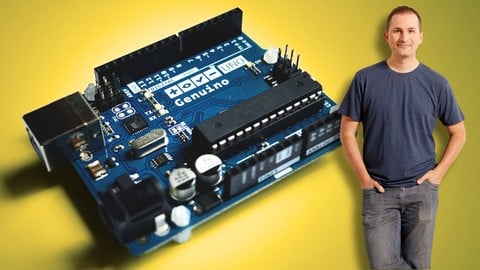
Arduino Step by Step: Getting Started (2024)
4.7 (8,714 Reviews)
- Provider: Udemy
- Time: 21.4h
$159.99
 Reviews

By Grant Purdon on 9/14/2026
The course overview appears to cover the details I need to learn. I would suggest looking into using VScode IDE as an alternative as this growing in popularity.
By Krisi qyra on 6/27/2026
Very good course once you know the basics and are not a beginner. He explained MQTT, cloud, HTTP, and OTA all in one course, as briefly as possible. Many other instructors seem to prey on people’s money by making separate courses for each topic, but this guy did not. The best part of this course is that it is based on how a professional product is actually built and what it is based on. It does not use the Arduino IDE; instead, it uses the Espressif IDE, which is used in production. The only critique that keeps it away from perfection is the use of HTTP instead of HTTPS with certificates. Other than that, it is still a highly advanced and useful course for anyone interested in IoT and serious embedded development.
By Joel Wiesner on 3/30/2026
This was not a good match for me. It is too advanced. Also, the instructors voice is somewhat monotonous and not engaging. I have seen better videos that explain each step, and why it is being put in. Certainly not for a novice, beginner C programmer.
By Tom Descamps on 11/12/2024
Professional and quality content explained properly by a professional and you can tell. Years after publishing the author still bothers to respond to questions asked even if they might seem basic. This is the type of educational content that i was expecting.
By Marcelo Freitas Sena on 3/3/2024
Course is really good, it will provide a basis to develop other projects with a good doses of professional programming for ESP32 embedded system. It requires the student to have good experience with C and also a good knowledge of the ESP32, altough with the introduction in each of the chapters for the API's and main concepts, if you put a good effort reading the suggested topics, it will help to grasp the programming details. For sure it is worth if you want to work with the ESP32. May require for sure more readings/work. Congrats, great course!!!
By Anisa Stekovic on 12/20/2023
This is by far most extensive course on ESP32 implementation. It uses Espressif IDF and touches on every aspect you may encounter in your IoT application. However, It is not for the faint of heart. I will be going back to this course for years to come. Great job Kevin, I hope you will continue to put out content like this.
By JUAN ANDRES HERRERA RODRIGUEZ on 12/18/2023
Los ejemplos son muy útiles y van al grano, quizás demasiado. A mi parecer, quizas por mi bajo conocimiento del entorno, se hace algo complejo comprender algunos conceptos que dificultan entender el proceso de programación al seguir el tutorial.
By Shashank Verma on 8/25/2023
Sorry for the earlier Review. After going through the lectures multiple times, I found them quite handy and fruitful. Thanks for this lovely content. I am happily waiting for the extension of this course series. (ESP IOT using Eclipse ESP-IDF and Google Firebase). Thanks in advance.
By Brendan Richart on 2/14/2023
The instructor does a good job of explaining the code, it's really difficult to find another course on ESP-IDF w/ IoT anywhere near as clear as this. Software installation was somewhat of a challenge but once you get past that, this course is great to get those wireless gadgets up and running
By Akhil Alugam on 7/1/2022
Questions asked were responded quickly and also the inputs given were helpful, but I felt like the code was just being read out while typing. The lectures were lacking the explanation and instructiveness. If a little amount of instructiveness along with a video cam recording would have felt more interactive.
 Quality Score
No CourseDuck member has rated this course yet. Taken it? Give each part a thumbs up or down.
Overall Score : 86 / 100

- Video Duration:
 8.8h
- Price: $74.99
- Provider: Udemy
- Updated:
 January 2026
- Level:
 All Levels
- Language:
 English
- Certificate:
 Yes
30-day money-back guarantee on most paid courses
Udemy Coupon Price Tracker
