
 Web Development
 Data Science
 Python
 SQL
 JavaScript
 Artificial Intelligence
 IT & Software
 IT Certifications
 Hacking
 AWS
 Arduino
 DevOps
 3D Modeling
 Graphic Design
 Photoshop
 Drawing
 Digital Painting
 UX Design
 Business
 Data Analysis
 Communication Skills
 Project Management
 Leadership & Management
 Human Resources
 Digital Marketing
 Social Media Marketing
 Marketing
 SEO
 Google Analytics
 Branding
 Excel
 Office Productivity
 SAP
 PowerPoint
 Microsoft Access
 SharePoint
 Finance & Accounting
 Trading & Investing
 Accounting
 Bitcoin
 Personal Finance
 Video Editing & Animation
 Photography
 Adobe Premier Pro
 Adobe Lightroom
 Personal Development
 Productivity
 Career Development
 Life Coaching
 Health & Fitness
 Meditation & Mindfulness
 Yoga
 Music
 Music Production
 Guitar
 Piano
 Singing
 Language Learning
 Teaching & Academics
 Engineering
 Math
 Lifestyle
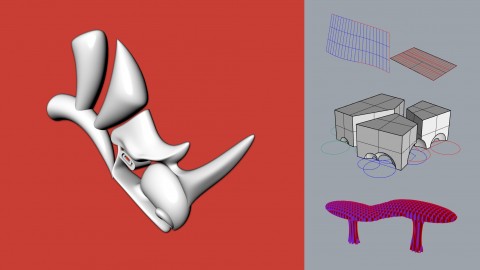
Model complex 3D architectural geometry with Rhinoceros (Udemy.com)
Learn to model freeform 3D with straight-forward example projects from real buildings, ready to apply in other projects
Created by: Stefan Boeykens
Last updated February 2015
 What you will learn
- creating complex 3D shapes and geometry, to model freeform, organic architecture
- break down a seemingly difficult shape into a logical sequence of geometric operations
- control the smoothness and continuity of the geometry with visual feedback from Rhinoceros
How it compares
Against the other 127 rated Udemy courses in Math on CourseDuck:
- Rating4.2 out of 5higher than 3% of them
- Reviews228#65 of 128 by number of reviews
- Length1.9 hoursshorter than 92% of them
- Last updatedFebruary 2015earlier than 99% of them
 Course Description
Update Feb. 2015: A new Section is in preparation, recreating the basic shape of a "Shell House". This will be available for all student members, so join the course now before the price is increased to $69.
This is a basic introduction and overview of modelling complex 3D Freeform shapes in the context of architectural design.
Have you ever wondered how certain architectural designs are actually created? You might assume that it is helped by software, but which system is suited for this? In regular CAD software that architects often use, such as AutoCAD or SketchUp, the creation of organic models and surfaces is hard to impossible.
We use Rhinoceros, a quite popular NURBS modelling software for McNeel. This is very popular within several innovative architectural offices where it is used for complex forms, organic architecture and extensive tweaking of 3D models. The software can also be used complementary to other architectural design software, although it is quite complete in itself.
The course starts with a basic introduction and overview of the software and then a few example projects are developed. They are inspired by famous and iconic architectural projects, but are not full reconstruction. We use the examples to inspire you and focus on a certain part of element which we will strip down to the basic geometric operations, giving you insight in how to approach more complex projects.
You don’t need any other software then Rhinoceros, on Windows or OSX, but be ready to try and fail, often. As many modelling tasks require a specific order of operations. We cannot prepare a solution for every possible task, but by building upon a few basic examples, you learn an approach which focuses on dividing the task at hand into smaller problems, that are easier to tackle. And these can then be applied in other situations.
So come join us and learn the basics of 3D Freeform Modelling with Rhinoceros.

 Udemy Discount
The discount is applied through our link. Open the course from here and Udemy's current promotional price is applied at checkout on most courses, no code to type.
Some courses are excluded from Udemy's promotions. If the price does not drop, clear your browser cookies and use the button again.
Instructor Details

- 4.2 Rating
 228 Reviews
Stefan Boeykens
Stefan Boeykens is an architect-engineer from Belgium.
After graduation, he worked a few years as a professional architect, for several local offices, where he was involved in design, building permits, drafting, site supervision, visualisation and IT management.
At the end of 2000, he got the opportunity to return to his former university (KU Leuven), at the Department of Architecture, where he started teaching Computer Aided Architectural Design. Initially AutoCAD and 3D Studio VIZ, but step-by-step, he introduced SketchUp, Rhinoceros + Grasshopper, ArchiCAD, Artlantis, Unity, Processing and Cinema 4D. He completed a PhD on Building Information Modelling in 2007 and worked a few years as a post-doc, focusing on the use of BIM throughout the design process. He became familiar with a wide variety of IT skills: Windows, OSX, Linux, VBA in Excel, php, C++, Java/Processing, Autolisp and C # in Unity.
At the moment, Stefan is a part-time guest professor at KU Leuven, teaching Building Information Modelling.
In parallel, he is working as a senior Innovation and BIM manager/consultant for D-Studio, a Belgian company focusing on BIM middleware and consultancy. He is a frequent speaker at BIM-related events and is actively involved in different professional working groups on BIM standardisation, including CEN/TC 442 (Europe) and TC BIM & ICT + CLUSTER Digital Construction (Belgium).
 More courses by Stefan Boeykens
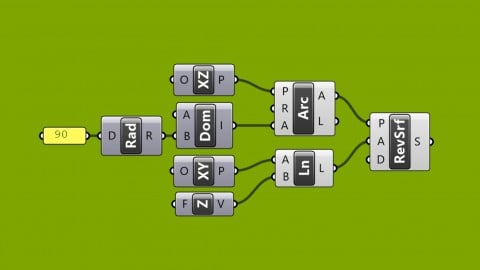
Develop Parametric Architecture with Grasshopper (2017)
4.3 (502 Reviews)
 Provider: Udemy
 Time: 3.6h
$59.99
More Math courses


Differential Equations with the Math Sorcerer (2026)
4.9 (704 Reviews)
- Provider: Udemy
- Time: 11.6h
$10.99


Precalculus 2: Polynomials and rational functions (2026)
4.9 (207 Reviews)
- Provider: Udemy
- Time: 42.1h
$74.99
 Reviews

By Rishi Gupta on 11/27/2017
The course is good as an introduction to the students practicing architecture, or professionals who want to get into Rhinoceros software. Though the explanations were not proper and in-depth which raises a lot of questions for the freshers. The thing I really liked was the fact that the instructor took some live examples instead of forming their own and broke them down for us to understand how they could be modeled, though they just give a reference to the method for approaching the designs. A full modeling of the example taken would have given an actual understanding to a newbie of how architectural modeling can be done in Rhino. Overall, it is helpful for fresh students to Rhino but could still have improved in the explanation of tools and methods of modeling, with an extended duration of the whole course.
By Giulio Venier on 8/2/2017
I think the explanations are very clear, no room for big talks, but straight into the application of commands. This is what I was looking for so long. Thank you. I don' leave 5 stars only because I feel there are many more commands to explore in Rhino. But if you are interested in something that can bring you from zero to a good level of modeling, this is what you need.
By Sajun Gunnoo on 7/17/2017
The course is interesting, but the video stops frequently and this affect the good flow of the lesson. I have updated my review after completing the course. I have surely learnt a lot of techniques and there are still more commands to be mastered.
By Ross Winterton-Selby on 4/26/2017
Good content, and knowledge, I come from old systems and autocad 10 was first CAD for me, please slow down your mouse movements and intstructions, combine the timing of both, the message will stick first time! or it would be 5 stars :-)
By I D on 3/29/2017
The curse is fast and covered almost all the basic functions of Rhino but left out some other that are useful too. Probably with one more chapter could have been a more complete course. But I liked it a lot as an introductory course, because the tools are implemented in real case modeling scenarios and not only in random geometries.
By John Sutherland on 2/9/2017
The course is most definitely aimed at beginner level, though isn't tiresome for anyone with experience in alternative modelling software. A number of parallels are made with Autocad and 3dsm which helps with a greater understanding overall. The pace is excellent, not moving too quickly or skipping over important details. Highly recommended for anyone looking for a basic grounding in Rhino.
By Dan Robert Richardson on 8/28/2016
I had some background with Rhino coming in. What was the most interesting and exciting was modeling the Metropol Parasol. I've always respected it and have wondered "how to do it". I find alot of operations are easier in Rhino than Revit, which I have more experience with. As a suggestion, it would be fascinating to redo the projects using Grasshopper. Remerci, Stefan. I look forward to any other classes you may offer. Abientôt.
By Александр Каргин on 9/5/2015
I enjoy the course a lot, and hope it will be useful also. The course seems pretty easy even for those who just doing first steps in modeling. But I think it's because of the course material based on real existed architectural objects and are constructed just in right order. Thank you Stefan a lot! PS: besides; during the course i have modeled a tool for working with sheet metal, that i really need. and also get a few ideas in furniture to realize in closed future.
By Ashraff Aleem on 5/11/2015
He explains things very clearly but sometimes, he stumbles or leave awkwardly long pauses, probably due to the fact that English is not his first language but other than that, it was an excellent course and I hope that he would make a more advanced version to help hone our skills. I feel that a way to make this course a little better, is to give the students a project to make, with a step by step explanation as the answer key. This would help the students think and figure out what commands would be the most appropriate to use.
By Daan Van Cauteren on 2/17/2015
The course shows some of the basic principles of the software which is a great way to get started and experiment. What I think is a bit of a downfall is that often the reason behind the usage of a certain tool is not explained, ie: "Now we use this tool.". I think it's more interesting to, in addition of the basic principles, teach the actual meaning and such of the tool.
 Quality Score
No CourseDuck member has rated this course yet. Taken it? Give each part a thumbs up or down.
Overall Score : 84 / 100
- Video Duration:
 1.9h
- Price: $19.99
- Provider: Udemy
- Updated:
 February 2015
- Level:
 Beginner
- Language:
 English
- Certificate:
 Yes
30-day money-back guarantee on most paid courses
Udemy Coupon Price Tracker
