
 Web Development
 Data Science
 Python
 SQL
 JavaScript
 Artificial Intelligence
 IT & Software
 IT Certifications
 Hacking
 AWS
 Arduino
 DevOps
 3D Modeling
 Graphic Design
 Photoshop
 Drawing
 Digital Painting
 UX Design
 Business
 Data Analysis
 Communication Skills
 Project Management
 Leadership & Management
 Human Resources
 Digital Marketing
 Social Media Marketing
 Marketing
 SEO
 Google Analytics
 Branding
 Excel
 Office Productivity
 SAP
 PowerPoint
 Microsoft Access
 SharePoint
 Finance & Accounting
 Trading & Investing
 Accounting
 Bitcoin
 Personal Finance
 Video Editing & Animation
 Photography
 Adobe Premier Pro
 Adobe Lightroom
 Personal Development
 Productivity
 Career Development
 Life Coaching
 Health & Fitness
 Meditation & Mindfulness
 Yoga
 Music
 Music Production
 Guitar
 Piano
 Singing
 Language Learning
 Teaching & Academics
 Engineering
 Math
 Lifestyle
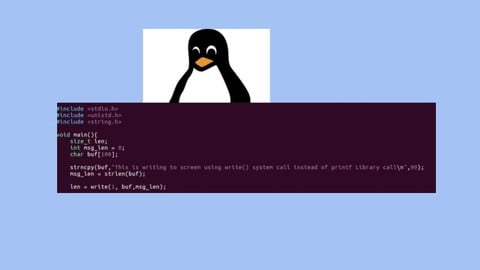
Linux System Programming - A programmers/Practical Approach (Udemy.com)
Files, Memory and Process management, Fork, Signals, Threads, IPC - Pipes, FIFO, message Queue, Semaphores,Shared Memory
Created by: Mohan M
Last updated March 2026
Our take
Based on the ratings of 1,458 students, a sample of their written reviews and the syllabus, as the course stood in March 2026. No course pays to be reviewed.
This is a C-based tour of Linux system programming. It covers file I/O, virtual memory, processes and fork, signals, POSIX threads, mutexes and condition variables, then pipes, FIFOs, message queues, semaphores and shared memory, all demoed on Ubuntu. It runs about 9.6 hours across 73 lectures. The course does not teach C, so the requirement of basic C is real. Mohan M has 20 years in embedded work and is a working engineer, not a full-time trainer, and the description says so. The material was last updated in March 2026.
Students who liked it say the explanations are clear and the theory comes with plenty of examples. One reviewer likes that it avoids getting too technical, and another calls the thread and process material a good entry point. The complaints are mostly about delivery. Reviewers mention a slow pace, long pauses, weak audio, a strong accent in the first lessons, and switching between slides and terminals. Slides and some example code can't be downloaded, and file names don't always match. Two reviewers also miss sockets, and one wants more on debugging.
About four in five of the 1,458 ratings are four or five stars, and the average is 4.2. The low scores come mostly from presentation, not wrong content, though one reviewer who took it for work found it missing topics like dynamic libraries and descriptor multiplexing, and another called the concepts too basic. Treat it as a first pass or interview prep for someone who already writes some C, not a full reference. Developers who need sockets or production depth should look elsewhere.
Pros
- Covers fork, signals, POSIX threads and five IPC mechanisms in one course
- Reviewers say explanations are clear and backed by working examples
- Stays accessible without drifting into heavy kernel theory
- Updated March 2026, with a students' Q and A section and debugging extras
Cons
- No sockets, dynamic libraries or I/O multiplexing, which reviewers wanted
- Slow pace, long pauses and screen switching hurt delivery, several reviewers say
- Slides and some example code are not downloadable, and file names do not match
Fantastic course. Easy to comprehend the topic without going too deep that might have made too technical for some students.
Labeled all levels, but basic C is required. It suits people new to Linux programming, not experienced systems coders.
 What you will learn
- From basics to advanced Linux systems programming, with lots of hands on 'C' programming demos.
- File operation, System call, Library functions, compiling using GNU-GCC, Blocking and Non Blocking call, Atomic operation, Race condition, User and Kernel mode
- Process Management - Process creation, termination, Fork() system call, child-parent process, command line argument of process, Memory Layout of Process
- Signals - signal handlers, sending signals to process, Default signal handlers.
- Posix Threads - Thread creation, thread termination, Thread ID, Joinable and detachable Threads.
- Thread Synchronisation - Mutex, Condition Variables
- Inter Process Communication (IPC)- Pipes, FIFO, Posix Message Queue, Posix semaphore, Posix shared memory
- Memory Management - Process Virtual Memory management, Memory segments(code, data, stack, Heap)
Course content
22 sections · 73 lectures · 9.6 hours of video 12 quizzes, 2 assignments, 12 articles
- 1Introduction to Linux 3 free previews4 lectures · 6 min
- 2System Programming Concepts 2 free previews4 lectures · 4 quizzes · 13 min
- 3File Operations6 lectures · 3 quizzes · 52 min
- 4Advanced I/O7 lectures · 6 quizzes · 46 min
- 5Introduction to Process 1 free preview6 lectures · 21 min
- 6Virtual Memory of Process5 lectures · 1 quiz · 29 min
- 7Memory Allocation4 lectures · 27 min
- 8Process Programming1 lecture · 17 min
- 9Process Monitor2 lectures · 50 min
- 10Advanced Process Programming6 lectures · 32 min
- 11Signals4 lectures · 48 min
- 12Threads6 lectures · 36 min
- 13Thread synchronisation2 lectures · 40 min
- 14IPC - Introduction 1 free preview1 lecture · 2 min
- 15PIPES and FIFO - Inter Process Communication2 lectures · 40 min
- 16POSIX - Message Queue1 lecture · 22 min
- 17POSIX - Semaphore2 lectures · 46 min
- 18POSIX - shared memory2 lectures · 23 min
- 19Extras - Linux Debugging Tools2 lectures · 21 min
- 20Closing Note1 lecture
- 21Extras 2 - Students Q & A4 lectures · 3 min
- 22Brainstorming/Interview questions1 lecture · 1 min
Who it is for
The instructor says it suits
- Students, and professionals (beginners) who want to explore Linux systems programming and learn product development using Linux OS
What you need before you start
- Should have basic C language understanding
How it compares
Against the other 124 rated Udemy courses in Linux on CourseDuck:
- Rating4.2 out of 5higher than 14% of them
- Reviews1,458#43 of 125 by number of reviews
- Length9.6 hourslonger than 62% of them
- Last updatedMarch 2026more recently than 71% of them
 Course Description
Note : This course is conducted by IT working Professional, and not by a Professional Instructor.
Q. What is the speciality of this course?
A. This is purely a Course on "Learning Programming using Linux", This course does not teach 'C'. Since this course is conducted by industry working professionals, This course tries to cover gap between academics and Industry, Also the last section Bonus - Students Q & A, contains the collective students questions and its solution to them. It is a regularly updating section.
Q. What is the Prior knowledge required for this course?
A. This course teaches from Basics of Linux Programming to Advanced, hence no prior knowledge on Linux is assumed, but should be energetic to learn Linux technology.
Q. Who is this course for?
A. This course is designed in mind from beginners(students) to intermediate professionals who want to learn Linux and Utilise the Open Source platform to help build their careers related in field of Linux systems Design and Development.
Q. What will be the outcome of this course?
A. The students upon completion will definitely have a SOLID understanding of Linux System Programming, For freshers this can be a good guide to crack interviews, for already working professionals they can start working as individual contributor in their projects, and definitely will be in par with the experienced colleagues.
Q. What are the contents of course?
In this course you will be learning the below Linux system programming. And more emphasis is given on the Programming part.
1. Introduction to Linux systems.
a. Linux architecture.
b. Writing 'Hello World' program, compiling using GCC and its execution.
2. What is system call and standard library function calls
3. Kernel and User mode in Linux
4. File operations
open(), close(), read(), write(), lseek()
Blocking and Non-Blocking calls.
Atomic operations, Race condition.
5. Memory Management and Virtual Memory
stack segment, code segment, heap segment, data segment,
Virtual memory management.
functions related to Memory allocation - Malloc(), calloc(), Realloc(), Auto variables, static variables.
6. Process Management
Process creation, Process termination, wait(), Process ID, fork() system call, Exec() family of system call, Parent-Child Process management,
Command line arguments of Process.
7. Signals
signal(), signal handlers, sending signals to process, ignoring and default signal actions.
8. Posix Threads
Thread creation, thread termination, thread ID, joinable and detachable threads.
9. Thread synchronisation
Mutex, Condition variables, Thread safe.
10. Posix - Inter Process communication.
Pipes, FIFO, Posix message Queue, Posix Semaphores, Posix Shared Memory.
NOTE - Ubuntu Distribution (Linux) is used for all Demo in this course.

 Udemy Discount
The discount is applied through our link. Open the course from here and Udemy's current promotional price is applied at checkout on most courses, no code to type.
Some courses are excluded from Udemy's promotions. If the price does not drop, clear your browser cookies and use the button again.
Instructor Details

- 4.2 Rating
 1,458 Reviews
Mohan M
1. Have 20 years of experience in Embedded technology and worked in various domains like IoT, Automotive, Consumer electronics, Infotainment systems Development, Bluetooth wireless systems development, Printers development, Products related to Safety critical Railway Signalling using Linux systems, Firmware etc.
2. Have working experience in Linux system Programming, C programming, Micro-controller based Embedded product development.
 More Linux courses

Learn Ubuntu Fast: Learn, Practice, and Advance your Career (2022)
4.8 (112 Reviews)
 Provider: Udemy
 Time: 6.6h
$69.99

Linux Mastery: Master the Linux Command Line in 11.5 Hours (2023)
4.7 (27,499 Reviews)
- Provider: Udemy
- Time: 10.7h
$24.99

The Linux Command Line Bootcamp: Beginner To Power User (2026)
4.7 (10,510 Reviews)
- Provider: Udemy
- Time: 15.8h
$109.99

Complete Linux Bash Shell Scripting with Real Life Examples (2026)
4.7 (4,978 Reviews)
- Provider: Udemy
- Time: 14.7h
$16.99
Complete Linux Troubleshooting Course (Practical Examples) (2026)
4.7 (2,231 Reviews)
- Provider: Udemy
- Time: 17.1h
$119.99
 Reviews

By Kshitij Shankar Sabale on 7/30/2026
Giving 1 star as of lecture 6. Not really intuitive. Will update later if found interesting. Edit: On lecture 45 - Process Programming and virtual memory sections are explained well. Updated my review.
By Aravind on 10/25/2025
review 1 its bascially reading the ppt aloud. I just started the session as of now its 1 star for me. review 2 the sessions are self explatorywe just need the ppt. i loved the practical approach which made the different system calls more undertandable. changeing my review to 3 star.
By Haribabu Morampudi on 12/20/2024
content and explanation is good, i will recommend this course to start linux system programming and to get basic idea about concepts. Suggestion to Trainer: It would really help If you can add your more realtime experience content to course and explain more application oriented .Thank you.
By Jack Suppe on 3/13/2024
The course has been very good so far! I have learned a lot of what I need in a short time. Illustrated with code examples that are explained and you know what happens. The topic is a bit hard why I bought the course in the first place. It requires a goot bit of knowledge about pointers in c, for which I also bought a course.
By KSS Ravi Teja on 3/11/2024
excellent course for beginners in system programming, you will get good foundation, only thing is the ppt are not present in resource section so could not download it, but you can download code files, i highly recommend it, instructor is very clear and had good knowledge , expecting more courses from him, thank you sir.
By Ariel on 3/26/2023
Started bad, to much basics. Some of them aren't even linux related but C related. The content gets more interesting & internal as the course continues. I think you should remove things that aren't linux/OS related like: printf/malloc/calloc. Do more: importent structures, API's. Maybe even Make/Cmake
By Roman Taniushin on 11/25/2022
The quality of the course matches its price: 20 euros. I was asked by my employer to do this course and I did it. I don't know why they chose this course, possibly because of the price. This is not to say that this is a complete wasting of time, some information was useful, but the course doesn't cover a lot of important topics, like e.g. dynamic libraries, socket programming, or descriptor multiplexing, or nonblocking I/O and so on. Instead they tell us e.g. how to use unnamed semaphores, which, in my opinion, isn't very useful in practice. Also there is a lot of repetitions. For example the speaker tells us many times how to use manual pages, which is pointless. They could tell it only once. Similarly every time we see file permissions the speaker again and again feels obliged to explain us what they mean. And finally the speaker doesn't seem to be well-prepared, there are a lot of interruptions in his monotonic speach. I listened it at the velocity at least 1.5 and sometimes increased it to 2, otherwise I would fell asleep. And the code examples deserve a separate section. There are unused variables, unused includes, the code is not well formatted, indentations are inconsistent - even within a single source file, variable names with indexes, source files with indexes, blank lines don't correspond logical blocks. So in the end I firsrt re-formatted the code and then tried to understand it. Also printf's are strange: for some reason they include " " in the beginning of many lines. No idea, why. Sometimes I even didn't go into their code and wrote it by myself in order to understand the functions. And one more repetition: in the section about named semaphores they wrote (and explained) four programs, while there was enough only the first one. Finally I comforted my employer with this certificate but I', m not going to show it to someone else. And if a person really wants to know about programming in Linux, I would recommend the book of Stevens that covers much more and doesn't explain the same things many times.
By Ronald Sebastian Kristijanto on 9/12/2021
This is unbelievably easy to understand ! ... After getting confused by W. Richard Stevens' and my university lecturer this course is like a piece of cake ! LOL ! ... The explanations Mohan in the practical videos are freaking easy to understand and just like watching a TV series ! Thank you so much !
By C Mahesh on 2/26/2021
it is perfect solution for someone familiar with embedded OS concepts, who wants to get grasp of some important issues in depth. personally ,I learn some amazing things from basics & its helpful for my job also. sir everything you explained in clear way,,Thank you
By praveen kumar muppalla on 1/1/2021
this is very good Linux course with lots of example programs for every concepts. if there were some real time examples for every concept ( the one you took,like for booking tickets application) it would have been exceptional
 Quality Score
No CourseDuck member has rated this course yet. Taken it? Give each part a thumbs up or down.
Overall Score : 84 / 100
- Video Duration:
 9.6h
- Price: $74.99
- Provider: Udemy
- Updated:
 March 2026
- Level:
 All Levels
- Language:
 English
- Certificate:
 Yes
- Lectures:73 in 22 sections
- Practice:12 quizzes
- Students:9,339
- Subtitles:5 languages
30-day money-back guarantee on most paid courses
Udemy Coupon Price Tracker
