
 Web Development
 Data Science
 Python
 SQL
 JavaScript
 Artificial Intelligence
 IT & Software
 IT Certifications
 Hacking
 AWS
 Arduino
 DevOps
 3D Modeling
 Graphic Design
 Photoshop
 Drawing
 Digital Painting
 UX Design
 Business
 Data Analysis
 Communication Skills
 Project Management
 Leadership & Management
 Human Resources
 Digital Marketing
 Social Media Marketing
 Marketing
 SEO
 Google Analytics
 Branding
 Excel
 Office Productivity
 SAP
 PowerPoint
 Microsoft Access
 SharePoint
 Finance & Accounting
 Trading & Investing
 Accounting
 Bitcoin
 Personal Finance
 Video Editing & Animation
 Photography
 Adobe Premier Pro
 Adobe Lightroom
 Personal Development
 Productivity
 Career Development
 Life Coaching
 Health & Fitness
 Meditation & Mindfulness
 Yoga
 Music
 Music Production
 Guitar
 Piano
 Singing
 Language Learning
 Teaching & Academics
 Engineering
 Math
 Lifestyle
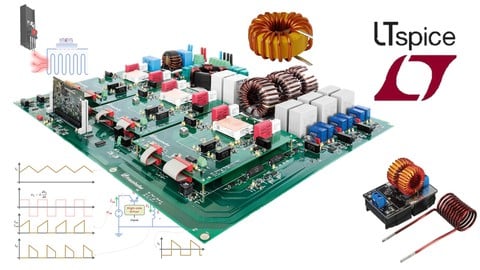
Basics of Power Electronics (Udemy.com)
Si, SiC, GaN, LTSpics, DC/DC converters, Inverters, power dissipation, thermal stresses
Created by: Walid Issa
Last updated April 2023
 What you will learn
- This course introduces you to the basics of Power Electronics including switches, Inverters, DC/DC converters and all that supported by LTSpice
- You will be able to calculate the power dissipation and thermal stresses for different group of waveforms on switches
- You will be able to analyse the DC/DC Converters: Buck, Boost, Buck Boost
- You will be able to analyse the inverters and the current flow in bridges
- You will be able to use LTSpice to test and design different converters and assess its effeciency
How it compares
Against the other 335 rated Udemy courses in Engineering on CourseDuck:
- Rating4.4 out of 5higher than 39% of them
- Reviews1,575#54 of 336 by number of reviews
- Length18.2 hourslonger than 89% of them
- Last updatedApril 2023earlier than 60% of them
 Course Description
This course introduces you to the basics of Power Electronics including switches, Inverters, DC/DC converters and all that supported by LTSpice. We cover here how to calculate the power dissipation and thermal stresses for different groups of waveforms on switches by hand and using LTspice. That includes sizing the heat sink and enabling you to decide whether active cooling is required. We introduce you to Silicon, Silicon Carbide and Gallium Nitrate switches and the main differences to enable you to choose the best for an application. You will be able to analyse the DC/DC Converters: Buck, Boost, Buck-Boost and inverters and understand how the current flows in a circuit and to derive the steady state relations between the input and the output.
LTSpice is used to validate the calculation and help to calculate a converter efficiency. We use LTSpice to design a closed-loop Buck converter. All that is supported by problem sets and labs. Problem sets are a group of problems that we supply for you to practice your understanding and we supply also the solutions. For the labs we introduce you to some tasks that will help you to conquer LTspice.
We are expecting you to engage totally with the course and give enough time to understand each part and practice the problem sets. I am confident that will be an excellent course for you to understand any more advanced topics in power electronics.

 Udemy Discount
The discount is applied through our link. Open the course from here and Udemy's current promotional price is applied at checkout on most courses, no code to type.
Some courses are excluded from Udemy's promotions. If the price does not drop, clear your browser cookies and use the button again.
Instructor Details

- 4.4 Rating
 1,575 Reviews
Walid Issa
I am an Electrical Engineer and have a PhD in Renewable Energy Engineering from Exeter University, UK. I have a passion to learn and teach electronics and other related courses. I produce videos on YouTube about how electronic circuits work and review several electronic stuff. I am now an Associate Professor at SHU teaching Electronics and Power Electronics and I hope you enjoy my courses here.
 More Engineering courses
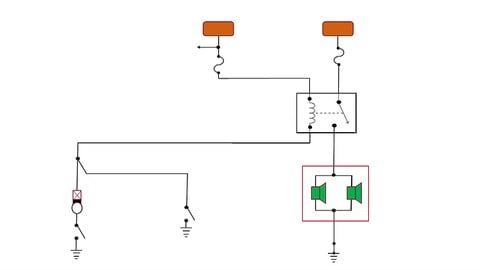
Do it Yourself - Automotive Electrical Diagnosis - Beginner (2026)
4.8 (1,897 Reviews)
 Provider: Udemy
 Time: 2.1h
$12.99
ROS 2 for Beginners Level 2 - TF | URDF | RViz | Gazebo (2025)
4.8 (1,869 Reviews)
- Provider: Udemy
- Time: 13.8h
$10.99
Advanced Kalman Filtering and Sensor Fusion (2021)
4.8 (1,033 Reviews)
- Provider: Udemy
- Time: 8.3h
$84.99

Digital Electronics: Robotics, learn by building module II (2020)
4.8 (942 Reviews)
- Provider: Udemy
- Time: 13.1h
$14.99

 Reviews

By Mvadr on 2/12/2026
Don’t buy this course as it is free on YouTube . I feel scammed
By Bart Mellenbergh on 12/8/2025
I have an interest in electronics but no electronics education. The lucid explanation that Walid gives provides me with the necessary understanding not only how a certain circuit works but why it works, based on the operational characteristics of the constituent components, and why you might consider such a circuit and not others.
By Anonymized User on 8/1/2025
The simulator program is good. Your knowledge of electronics is also good. This course had a very high amount of math that sometimes took some time to absorb and understand.
By Sunney Kumar on 4/13/2025
This course covers from basic to little advance level. It is a good refresher for experience engineers and must watch for beginners. The LTSPICE tutorials in between are cherry on the top.
By Roberto Santiago on 12/14/2024
Your course expanded my knowledge. There were some aspects that I did not learn in college that I was able to learn and understand through your videos.
By Vincenzo Aprea on 5/14/2024
This is a great experience for me , very good teaching, the arguments are very complete for a basic knowledge of Power electronics and explained simply. I'm very satisfied.
By Vishal Vishwambharan on 10/9/2023
Fantastic course! Walid explains inverters and converters with great depth. Using LTspice made grasping electronics concepts much simpler. Would strongly suggest folks to enrol in this course.
By Filip Garmaz on 9/23/2023
This course was very well done. The lessons were detailed and the concepts of power losses and how to calculate them were well explained. The only thing I didn't like about the lessons is that some lessons were too monotonous, theoretical and abstract (especially high-order math/calculus equations). I also really liked the tasks and problem sets after every few sections. The tasks were not too easy, but not too hard either, which made them challenging to solve. I like how those tasks can make participants actively think about power electronics problems and how to solve them. Overall, this course is worth taking, because even though it can sometimes be hard, it makes one really learn what to consider when designing circuits to avoid overheating components and wasting power.
By Fahhaam Aatir on 6/5/2023
A very informative course with relative Powerpoint Presentations. The tutorials in between are great as they help to implement the learned objectives in reality. The linking of course learning to the practical world is something I enjoyed the most. I deduct half a star because I believe the Lectures could have been made better and more professionally and audio quality could be improved too.
By Mark Gillis on 1/10/2023
I found this to be a great course with excellent content. The instructor provided very clear and to the point explanations and examples. I took off 1/2 star because I would have liked to see the content expanded (or an additional course provided ) to include the theory, principles and practical considerations behind the magnetics required for the converters, information regarding the control loops, converter stability, (e.g. loop differences between CCM and DCM modes), transient response topics, AC analysis and similar content for isolated converter topologies, e.g. forward, flyback, push-pull, etc.
 Quality Score
No CourseDuck member has rated this course yet. Taken it? Give each part a thumbs up or down.
Overall Score : 88 / 100
- Video Duration:
 18.2h
- Price: $12.99
- Provider: Udemy
- Updated:
 April 2023
- Level:
 All Levels
- Language:
 English
- Certificate:
 Yes
30-day money-back guarantee on most paid courses
Udemy Coupon Price Tracker
