

Mastering Shear Force and Bending Moment Diagrams (Udemy.com)
Civil Engineering Essentials - Your complete roadmap to mastering these structural analysis skills
Created by: Dr Sen Carroll
Produced in 2021
 What you will learn
- You will be fully competent in drawing shear force and bending moment diagrams for statically determinate beams and frames.
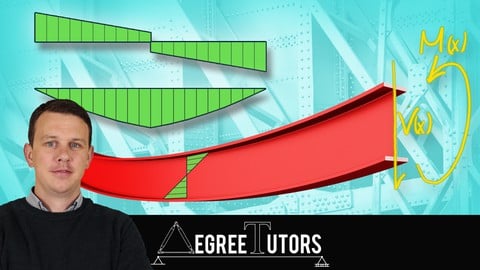
- You will understand the relationship between external loading and the shear forces and bending moments they induce.
- You will understand the link between internal stresses and their shear force and bending moment resultants.
- You will have a robust system of analysis that allows you to confidently tackle the analysis of any statically determinate structure.
 Quality Score
Overall Score : 94 / 100
 Course Description
We'll focus on pinning down the basics before diving into worked examples.
If you follow all lectures and attempt all of the worked examples, by the end of the course you will have an excellent grasp of this essential civil engineering skill!
Section 1: Reviewing the basicsBefore we get into the detail of shear force and bending moment diagrams, first we need to do a little housekeeping. We'll clarify a few assumptions that apply to our analyses and make sure you can determine support reactions for statically determinate structures.
Section 2: Understanding internal bending moments
In this section we start laying the foundation for your understanding of bending moments. We kick things off by considering how the bending moment relates to the state of stress within the structure - we're trying to answer the question 'what is the bending moment telling us about the state of stress within the structure?'.
Then we'll see how the principle of equilibrium allows us to determine the internal bending moment at any point within the structure. This will prepare us nicely to start thinking about how the bending moment changes along the structure.
We'll wrap this section up with some worked examples to make sure you understand everything we have discussed in the section.
Section 3: Understanding internal shear forces
Everything we've done for bending moments we're going to now do for shear forces:
relating shear stress to shear forcecutting the structure to reveal the internal shear forceintroducing a sign conventionAs always we'll confirm you understand everything by completing some worked examples.
Section 4: Differential relationships between loading, shear force and bending moment
In this section we take our understanding to the next level. We're going to establish the relationships (and rules) that allow us to systematically build bending moment and shear force diagrams - 100% accurately every time. By the time you complete this section, you will understand how these diagrams can be developed in a systematic way, ensuring success every time.
Section 5 & 6: Bringing it all together - Worked ExamplesIn these final two sections we reinforce everything you have learning so far. Remember, structural analysis, like any other skill only improves through practice. By putting everything you have learning over the previous 4 sections into action here, you're ensuring the skills are embedded.
We will start on familiar ground in section 5 by considering beam structures. In section 6 we'll map what you have learned onto frame structures - greatly expanding the applicability of the tools and techniques you have developed in this course!
At this point you can confidently analyseany statically determinate structure you're likely to come across in your civil engineering studies orcareer. Next step...
statically indeterminate structures!
Who this course is for:
Students who know they should be able to but struggle to reliably draw shear force and bending moment diagrams.
Students who have not yet come across the concepts of shear force and bending moments and want to get a head start.
Students outside of traditional engineering disciplines, architecture students for example, who want to better understand how structures respond to loading.
More advanced engineering students to want to give themselves a refresher - a good idea before a technical job interview!

 Instructor Details

- 4.7 Rating
 34 Reviews
Dr Sen Carroll
Im Dr Sen Carroll, a senior lecturer in structural engineering at the University of Exeter in the UK. Structural engineering and engineering education are things Im very passionate about. I graduated with a first in structural engineering from Dublin Institute of Technology in 2006. I have a masters degree in civil engineer and a PhD in structural dynamics (crowd-induced structural vibration).
After getting my degree I worked for several years in Dublin as a structural design engineer. After completing my PhD in 2013 I took up an assistant professor post at the University of Nottingham. This was followed by a 3 year stint as an assistant professor at the University of Warwick. Following a move to Cornwall in 2016, I joined the University of Exeter as a senior lecturer in structural engineering.
Im also a chartered engineer with Engineers Ireland (Im Irish by the way!) and a Fellow of the Higher Education Academy.
 Reviews

- Video Duration:
 8.5h
8.5h - Price: 11.99 Track Price 11.99 Track Price
- Provider:
 Udemy
Udemy - Year:
 2021
2021 - Language:
 English
 - Certificate:
 Yes
Yes

30-Day Money-Back Guarantee
Udemy Coupon Price Tracker
