
 Web Development
 Data Science
 Python
 SQL
 JavaScript
 Artificial Intelligence
 IT & Software
 IT Certifications
 Hacking
 AWS
 Arduino
 DevOps
 3D Modeling
 Graphic Design
 Photoshop
 Drawing
 Digital Painting
 UX Design
 Business
 Data Analysis
 Communication Skills
 Project Management
 Leadership & Management
 Human Resources
 Digital Marketing
 Social Media Marketing
 Marketing
 SEO
 Google Analytics
 Branding
 Excel
 Office Productivity
 SAP
 PowerPoint
 Microsoft Access
 SharePoint
 Finance & Accounting
 Trading & Investing
 Accounting
 Bitcoin
 Personal Finance
 Video Editing & Animation
 Photography
 Adobe Premier Pro
 Adobe Lightroom
 Personal Development
 Productivity
 Career Development
 Life Coaching
 Health & Fitness
 Meditation & Mindfulness
 Yoga
 Music
 Music Production
 Guitar
 Piano
 Singing
 Language Learning
 Teaching & Academics
 Engineering
 Math
 Lifestyle
Matlab course for wireless communication engineering (Udemy.com)
A step by step the Matlab codes for BER estimations of different Comm. systems like OFDM and NOMA Comm. systems
Created by: Dr. Khaled Ramadan
Last updated February 2021
 What you will learn
- How to estimate the Bit-Error-Rate (BER) performance of different modulation schemes like BPSK, QPSK, 16QAM, 64QAM, and 256QAM over an Additive White Gaussian Noise (AWGN) channel?
- How to generate and add a Rayleigh fading channel based on the Jakes model?
- How to mitigate the Rayleigh fading channel effect using different linear equalizer schemes?
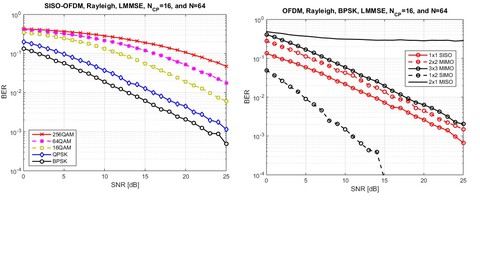
- How to estimate the Bit-Error-Rate (BER) performance over Single-Input-Single-Output Orthogonal Frequency Division Multiplexing (SISO-OFDM) communication system over a Rayleigh fading channel?
- How to extend this work for different Multiple-Input-Multiple-Output (MIMO) configurations like 2×2, and 3×3 MIMO-OFDM communication systems over a Rayleigh fading channel?
How it compares
Against the other 335 rated Udemy courses in Engineering on CourseDuck:
- Rating4.4 out of 5higher than 39% of them
- Reviews181#238 of 336 by number of reviews
- Length3.5 hoursshorter than 65% of them
- Last updatedFebruary 2021earlier than 74% of them
 Course Description
This is course is designed for under and post graduate students associated to the electronics and communication engineering department. It has 10 introductions of 30 minutes, each introduction discusses the theoretical explanation and the simulated figures that obtained through the explanation of the course. This course saves many months of hard work.
Using the Matlab program, you will learn:
1-How to estimate the Bit-Error-Rate (BER) performance of different modulation schemes like BPSK, QPSK, 16QAM, 64QAM, and 256QAM over an Additive White Gaussian Noise (AWGN) channel?
2-How to generate and add a Rayleigh fading channel based on the Jakes model?
3-How to mitigate the Rayleigh fading channel effect using different linear equalizer schemes?
4-How to estimate the Bit-Error-Rate (BER) performance over Single-Input-Single-Output Orthogonal Frequency Division Multiplexing (SISO-OFDM) communication system over a Rayleigh fading channel?
5-How to extend this work for different Multiple-Input-Multiple-Output (MIMO) configurations like 2×2, and 3×3 MIMO-OFDM communication systems over a Rayleigh fading channel?
6-A general code for BER estimation in case of Nt×Nr configuration for OFDM communication system over a Rayleigh fading channel will be presented, where Nt, is the number of transmitting antennas, and Nr is the number of receiving antennas.
7-Finally, the BER estimation for Non-Orthogonal Multiple Access (NOMA), which used in the 5G communication systems will be presented.

 Udemy Discount
The discount is applied through our link. Open the course from here and Udemy's current promotional price is applied at checkout on most courses, no code to type.
Some courses are excluded from Udemy's promotions. If the price does not drop, clear your browser cookies and use the button again.
Instructor Details

- 4.4 Rating
 181 Reviews
Dr. Khaled Ramadan
Khaled Ramadan Mohamed received his B Sc. degree from the Higher Institute of Engineering, Al Shorouk City, Egypt, in 2011, and both his M Sc. and Ph.D. degrees from the Faculty of Electronic Engineering, Menoufia University, Egypt, in 2018 and 2021, respectively. Since 2021, he has been working as an Assistant Professor in the Communication and Computer Engineering Department at the Higher Institute of Engineering, Egypt. In September 2024, he joined the Department of Telecommunication Engineering, College of Engineering, Ahlia University, Manama, Bahrain, as an Assistant Professor. Throughout his academic career, he has also served as a deputed Assistant Professor at several institutions in Egypt, including the Higher Technological Institute for Engineering and the Higher Institute for Aviation and Communications.
 More courses by Dr. Khaled Ramadan
More Engineering courses

Do it Yourself - Automotive Electrical Diagnosis - Beginner (2026)
4.8 (1,897 Reviews)
 Provider: Udemy
 Time: 2.1h
$12.99

ROS 2 for Beginners Level 2 - TF | URDF | RViz | Gazebo (2025)
4.8 (1,869 Reviews)
- Provider: Udemy
- Time: 13.8h
$10.99

Advanced Kalman Filtering and Sensor Fusion (2021)
4.8 (1,033 Reviews)
- Provider: Udemy
- Time: 8.3h
$84.99

Digital Electronics: Robotics, learn by building module II (2020)
4.8 (942 Reviews)
- Provider: Udemy
- Time: 13.1h
$14.99

 Reviews

By Hridoy Banik on 10/6/2025
No theoretical explanation at all. Language is not also clear.
By Daniel Olsen on 6/4/2024
I would say this is quite interesting, and i am really getting along with, the concept of this course is really an amazing and interesting
By Switzer Quadri on 6/4/2024
Instructor really an expert, in line with the Matlab course for wireless communication engineering the instructor is really an expert in that
By Bamidele Goodnews on 5/25/2024
This course i one of the best course have ever enrolled in my academic history ad it's really giving me goosebumps
By Adewole Ibrahim on 5/25/2024
A well applause to M. Khaled for giving us this wonderful course, it is a very good experiencing this well detailed course
By Poornima Aswath Narayana on 8/24/2023
could create some kind of loop for differentiating QPSK and BPSK in plots
By Dan D. on 4/15/2022
Really helpful to have good understanding how to write a simple Matlab codes for wireless communication systems. Thankyou so much
By Francisco Hernandez on 11/2/2021
It is a quick and useful introduction to PHY simulation using MATLAB. Kudos to the professor.
By Islam Zakaria on 1/19/2021
It is amazing over my expectations for both of the material and the instructor which is more qualified I learned from him. Thank You for all of you.
By Vinay Trivedi on 1/12/2021
A very informative course for researchers beginning their career in the areas of wireless communication.
 Quality Score
No CourseDuck member has rated this course yet. Taken it? Give each part a thumbs up or down.
Overall Score : 88 / 100
- Video Duration:
 3.5h
- Price: $10.99
- Provider: Udemy
- Updated:
 February 2021
- Level:
 All Levels
- Language:
 English
- Certificate:
 Yes
30-day money-back guarantee on most paid courses
Udemy Coupon Price Tracker
