
 Web Development
 Data Science
 Python
 SQL
 JavaScript
 Artificial Intelligence
 IT & Software
 IT Certifications
 Hacking
 AWS
 Arduino
 DevOps
 3D Modeling
 Graphic Design
 Photoshop
 Drawing
 Digital Painting
 UX Design
 Business
 Data Analysis
 Communication Skills
 Project Management
 Leadership & Management
 Human Resources
 Digital Marketing
 Social Media Marketing
 Marketing
 SEO
 Google Analytics
 Branding
 Excel
 Office Productivity
 SAP
 PowerPoint
 Microsoft Access
 SharePoint
 Finance & Accounting
 Trading & Investing
 Accounting
 Bitcoin
 Personal Finance
 Video Editing & Animation
 Photography
 Adobe Premier Pro
 Adobe Lightroom
 Personal Development
 Productivity
 Career Development
 Life Coaching
 Health & Fitness
 Meditation & Mindfulness
 Yoga
 Music
 Music Production
 Guitar
 Piano
 Singing
 Language Learning
 Teaching & Academics
 Engineering
 Math
 Lifestyle
Service Design: Designing for Experience Over Time (Udemy.com)
Learn how to structure new service innovations that deliver value to customers and users
Created by: Jon Kolko
Last updated February 2017
 What you will learn
- Analyze an existing service in order to judge its efficacy and value. This provides you with a language of criticism and evaluation.
- Think about experiences as a series of designed touchpoints. This is a new perspective on products, treating them as part of dynamic ecosystems.
- Understand how changes in one part of a system impact another part of a system. Systems thinking realizes that ecosystems are complex, and simple causality is hard or impossible to identify.
- Tell stories of how people experience designed artifacts. The ability to craft narratives becomes one of the most fundamental ways of communicating time-based interactions.
- Visualize how a person interacts with touchpoints in order to achieve a goal. These time-based visualizations bring narratives and stories to life in accessible, approachable formats.
How it compares
Against the other 144 rated Udemy courses in UX Design on CourseDuck:
- Rating4.5 out of 5higher than 61% of them
- Reviews9,160#10 of 145 by number of reviews
- Length1.2 hoursshorter than 90% of them
- Last updatedFebruary 2017earlier than 92% of them
 Course Description
Overview
This training program helps you leverage methods of design thinking in order to produce new and compelling service and system designs. It serves as a foundation for thinking about the behavioral touchpoints a user may have with your company, and how those touchpoints can be better designed to support a more comprehensive and purposeful brand experience.
The training program's primary emphasis is on diagramming and storytelling. You'll learn to create quick, low-fidelity representations of ideas, so you can test these ideas and improve upon them. By embracing diagramming, storytelling, and rapid prototyping, you'll be prepared to introduce a culture of making into your company or organization. You'll understand how to visualize complex ideas, how to minimize complexity, and how to simply illustrate changes in a complex system.
Grounding Principles
Experience. The experiences people have shape their views and perspectives, and the experiences people have with your brand shape the way they think about, judge, and interact with your company. Experience happens over time, and our curriculum focuses on the development of time-based artifacts that help tell stories of behavior. You'll learn to think about narrative structures, and consider products and services in a larger, experiential context.
Empathy. Often, we look internally at our own company’s processes, attitudes, and perspectives. Empathy means looking outwards, exploring the emotions and perspectives of our users and customers, and trying to see the world through their eyes. Our curriculum emphasizes forms of active empathy: exploring novel situations from a perspective of vulnerability in order to feel what customers feel.
Prototyping. Artifacts ground ideas in reality so that they can be critiqued, examined, and improved. Prototyping is a form of iterative making, in order to see ideas come to life. Prototypes can be collaboratively evaluated, and can be applied to products, services, and systems. Ideas can be developed at a variety of fidelities, and our curriculum emphasizes quick prototyping at rough stages of fidelity, in order to drive rapid improvement.
Skills Developed
You'll learn these practical skills:
- Scenario development and storyboarding. Written and visualized scenarios act as the underpinnings for time-based interactions. You will learn to craft believable, future-facing stories of how people use new services and systems.
- Customer journey mapping. Journey maps act as visual representations of how a person explores a service over time, showing connection points between people, products, policies, and interactions. These visuals can be used to illustrate both the problem (or existing) state of a service, as well as the future (or ideal) state of a service design.
- Service slices. Many services include human touchpoints, and these touchpoints often shape how we feel about the entire service experience. You will learn how to create various “slices” of a service in order to show information flow, sequences of interactions, and the power dynamics between actors in the system.
- Rapid prototyping. You will learn to visualize your ideas in two and three dimensions, showing how new service touchpoints will actually manifest. You will learn to prototype at different levels of fidelity, and to critique designs in order to improve upon them.

 Udemy Discount
The discount is applied through our link. Open the course from here and Udemy's current promotional price is applied at checkout on most courses, no code to type.
Some courses are excluded from Udemy's promotions. If the price does not drop, clear your browser cookies and use the button again.
Instructor Details

- 4.5 Rating
 9,160 Reviews
Jon Kolko
Jon is Partner at Modernist Studio, and the Founder and Director of Austin Center for Design. He was previously the Vice President of Design at Blackboard, the largest educational software company in the world. He joined Blackboard with the acquisition of MyEdu, a startup focused on helping students succeed in college and get jobs. His work focuses on helping design students develop autonomy through making. He has worked extensively with both startups and Fortune 500 companies, and he's most interested in humanizing educational technology.
Jon has previously held positions of Executive Director of Design Strategy at Thinktiv, a venture accelerator in Austin, Texas, and both Principal Designer and Associate Creative Director at frog design, a global innovation firm. He has been a Professor of Interaction and Industrial Design at the Savannah College of Art and Design, where he was instrumental in building both the Interaction and Industrial Design undergraduate and graduate programs. Jon has also held the role of Director for the Interaction Design Association (IxDA), and Editor-in-Chief of interactions magazine, published by the ACM. He is regularly asked to participate in high-profile conferences and judged design events, including the 2013 Cooper-Hewitt National Design Awards. He has taught at the University of Texas at Austin, the Center for Design Studies of Monterrey, in Mexico, and Malmö University, in Sweden.
 More courses by Jon Kolko
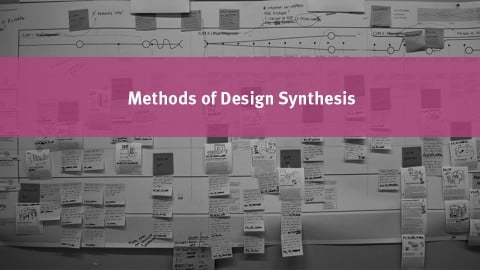
Methods of Design Synthesis: Research to Product Innovation (2013)
4.5 (426 Reviews)
 Provider: Udemy
 Time: 1.2h
$54.99

Product Management: Building Great Products (2017)
4.6 (376 Reviews)
- Provider: Udemy
- Time: 1.3h
$34.99
More UX Design courses

Learn Figma: User Interface Design Essentials - UI/UX Design (2022)
4.8 (1,791 Reviews)
- Provider: Udemy
- Time: 10.2h
$199.99

iOS 12 & Swift 5 - App Design, UI/UX plus Development (2022)
4.8 (955 Reviews)
- Provider: Udemy
- Time: 80.5h
$94.99
User Experience Design Essentials - Adobe XD UI UX Design (2025)
4.7 (46,830 Reviews)
- Provider: Udemy
- Time: 9.7h
$189.99
Learn Figma - UI/UX Design Essential Training (2023)
4.7 (18,337 Reviews)
- Provider: Udemy
- Time: 3.7h
$119.99

How To Design for Accessibility: for UX Designers (WCAG 2.2) (2026)
4.7 (7,863 Reviews)
- Provider: Udemy
- Time: 8.9h
$109.99

 Reviews

By Daniela Rosito on 8/5/2026
Un curso introductorio pero muy útil para quienes queremos encarar el diseño de servicios o implementar mejoras a los existentes.
By Vipin Sharma on 6/15/2026
course and course content was good and knowledgable.
By Sriram Venkitachalam on 5/3/2026
the course went into the spirit of service design and have a simple step by step framework on how to put it all together that had more depth than I expected. it's very well suited for professionals who want to elevate their thinking on service design. but i can also imagine doing the course as a group training activity with other professionals from my organization who may not be researchers or designers but will still get a LOT off it. loved it
By Arun Sahu on 4/16/2026
Good explanations relatable examples..
By Polina Chelpanova on 4/15/2026
The course has a good pacing and very easy to understand for an aspiring Service Designer, love it!
By Hemang Asher on 4/2/2026
Very useful and knowledgeable content.
By Gangadhara J on 1/23/2026
Good take on service design & great examples
By Laxmi Mohapatra on 1/18/2026
ITS GOOD TO APPEAR THIS TYPE OF COURSE.
By Caitlin Flannery on 11/13/2025
This was a great take on Service Design and how you can go from start to finish through a whole process. I would rate it at 4 stars because I'm not sure if it's quite at the intermediate level, I think a lot of beginners could get a lot out of this too. Would have liked if it was a little longer of a course with more concepts on how to keep moving forward with this in future work, but I think the Value Promise was something new I hadn't done before and can steer future conversations and work when applied.
By Anish Afonso on 10/22/2025
It was a good course which represents the service design process and provides different methods to conduct research. I would say its perfect for beginners. It would be nice to have a section where people can share their projects to obtain feedback.
 Quality Score
No CourseDuck member has rated this course yet. Taken it? Give each part a thumbs up or down.
Overall Score : 90 / 100
- Video Duration:
 1.2h
- Price: $34.99
- Provider: Udemy
- Updated:
 February 2017
- Level:
 Intermediate
- Language:
 English
- Certificate:
 Yes
30-day money-back guarantee on most paid courses
Udemy Coupon Price Tracker
