

Rocket Engineering and Interstellar Space Propulsion (Udemy.com)
Become a rocket scientist and understand the most advanced space propulsion technologies.
Created by: Eliott Wertheimer
Produced in 2018
 What you will learn
- Understand fundamental rocket theory including the rocket equation and how to derive it.
- Understand critical rocket design parameters and be able to use them.
- Understand the physical principles behind chemical rockets and their fundamental engineering (combustion, exhaust, cooling, propellant systems, etc).
- Understand the performance and difference between the propellant types used in current space launchers.
- Conduct basic calculations to size space launchers to reach orbit.
- Understand the need for and be able to size and calculate the performance of multiple stages space launchers.
- Understand the need for and different design schools behind reusable space launchers.
- Understand the physical principles and different technologies behind electric propulsion.
- Understand the physical principles and different technologies behind advanced interstellar propulsion concepts.
 Quality Score
Overall Score : 86 / 100
 Course Description
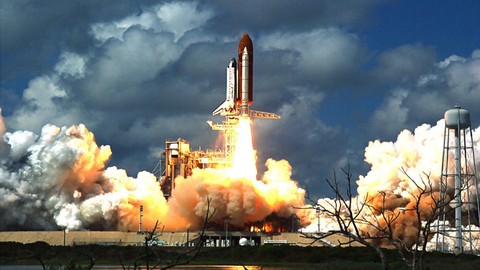
Space launchers and rocket propulsion systemsare what allowed us to spreadour spacecrafts from the Earth's orbit to theends of the Solar System. They lift buildings to the sky, takingrobots to Mars, enablingsatellites to continuouslytransform humancivilization and offering us the hope of one day spreading throughout the universe.
This course offers the opportunity to learn andunderstand:
-The Fundamental Principles of Rocket Science and Rocket Theory.- Chemical Rocket Design.- The Engineering and ChallengesBehind Expendable and ReusableSpace Launchers.- Electric and Low Thrust Space Propulsion .- AdvancedNuclear and Interstellar Space Propulsion.
I will thoroughly detail andwalk you througheach of these subjects andexplain down to their fundamental principles, all concepts and subject-specific vocabulary. This course is theideal beginner,intermediate or advancedlearning platform forRocket Scienceand the engineering around it. Whatever your background,whether you are a student, awriter, a sci-fi addict, acomputer scientist, an engineer,a business orsports person with an interest in Space, rockets or crazily powerful machines,you will understand the functioning and engineering behind our mostambitious technologies!
If you have questions at any point of your progress along the course, it will be my pleasureto answer any of yourquestions within 24 hours!
If this sounds like it might interest you, for your personal growth, career or academic endeavours, I strongly encourage you to join! You won'tregret it!
Who this course is for:
Anyone interested in understanding the way rockets and advanced space propulsion works.
Anyone interested in learning about the acme of human technological achievement.
Basically, anyone interested in becoming a rocket scientist. and bragging about it at parties and dinners.
 Instructor Details

- 4.3 Rating
 88 Reviews
Eliott Wertheimer
I have always been impressed and passionate about flying machines and the ultimate frontier that space represents. This led me to graduate from a Masters in Aerospace Engineering as one of the top students at a leading UK university. Throughout this degree I was offered the opportunity to understand and apply advanced engineering concepts to different design projects.
In my final year, I consequently designed a proof of concept nuclear battery or Radioisotope Thermoelectric Generator (refer to my courses to learn more about these) for nanosatellites which was judged by academics as one of the best projects of my department, won the Reaction Engines prize and presented at the 4th Interplanetary Cubesat Workshop. Similarly, I developed, with a team of colleagues, an unmanned rotorcraft able to fight fires, carry cargo and surveillance missions which eventually won a design competition for Agusta Westland.
I went on to found FuroSystems, a company which designs, manufactures and retails ultra light high performance electric vehicles. Our goal is to help accelerate society's transition to electric means of transportation through aesthetic, powerful and affordable machines. We are now present in over 30 countries and have sold 1000s of units.
I am very excited to be able to share my knowledge with curious individuals, who like me want to know more about the engineering behind the wonderful machines that populate our world.
 More engineering courses

Digital Electronics: Robotics, learn by building module II (2021)
4.8 (90 Reviews)
 Provider: Udemy
 Time: 13h
$11.99

Do it Yourself-Automotive Electrical Diagnosis-Intermediate (2021)
4.8 (83 Reviews)
- Provider: Udemy
- Time: 3h
$11.99

Crash Course Electronics and PCB Design (2021)
4.7 (312 Reviews)
- Provider: Udemy
- Time: 103.5h
$11.99


Electricity & electronics - Robotics, learn by building (2021)
4.7 (299 Reviews)
- Provider: Udemy
- Time: 10.5h
$11.99

 Reviews

- Video Duration:
 2.5h
2.5h - Price: 11.99 Track Price 11.99 Track Price
- Provider: Udemy
- Year:
 2018
2018 - Language:
 English
 - Certificate:
 Yes
Yes

30-Day Money-Back Guarantee
Udemy Coupon Price Tracker
